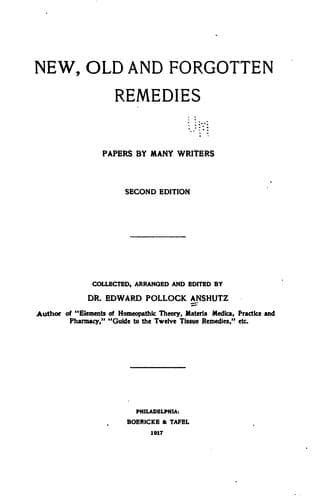
New, Old, and Forgotten Remedies: Papers by Many Writers
Science
New, Old, and Forgotten Remedies: Papers by Many Writers
Homeopathy -- Materia medica and therapeutics
6. As the stigmata of maize are a very powerful, though at the same time
entirely inoffensive diuretic, they have also been employed with the
best results in cases of heart disease, albuminuria, and other
affections requiring diuretics. Cases have been reported in which the
urinary secretion was tripled and even quintupled in the first
twenty-four hours, and others where the exhibition of the drug was
continued for two or three months without the slightest untoward effect.
(Though Dr. Dufan condemns the use of the remedy in
gonorrhoea, other practitioners have commended it for
that very purpose. Dr. Leo Bennett, _Therapeutic
Gazette_, 1893, having had "unusual success" in the
treatment of that disease with the _Stigmata maidis_.)
SUCCINIC ACID.
PREPARATION.--The pure chemical is triturated in the usual way.
(The following is by Dr. Morris Weiner, of Baltimore,
1892:)
About twelve years ago I decided to prove _Succinic acid_ (_Acidum
succinicum_). _Agricola_ mentions this acid, 1546, as _Salt of amber_.
_Boyle_, towards the close of the 17th century, was the first who
pronounced it to be acid, and _Stecker de Neuform_ confirmed this
statement, after repeated investigations, calling it a _true_ acid.
_Berzelius_ published its elemental composition, C_{4}H_{2}O_{3}.
This acid was long ago laid aside as obsolete, and not without good
reason, because since the Puritans in chemistry commenced to rule over
every laboratory of pharmacy, by trying to redistill this crude acid and
changing its yellowish color to snowy whiteness, they drove out every
trace of the _oily matter_ which alone constitutes its medical action.
The whiter this acid becomes the larger doses can be taken without any
action on the human system. Knowing that this _oil of amber_ is driven
out totally by redistillation I was compelled to prepare the crude acid
myself.
The expense is considerable. One pound of amber yields about half an
ounce of crude acid, and the glass retort, after dry distillation, must
be broken to collect the acid.
The fumes of _Acidum succinicum crudum_ are inflammable, producing
asthma, cough, sneezing, weeping, dropping of watery mucus from the
nostrils, pain in chest and headache.
None of our remedies gives a truer picture of hay fever, and since the
_oil of amber_ must be securely inclosed in the amber itself, it was but
natural to conclude that by trituration I may receive all the virtue of
the remedy.
At the same time I remembered that necklaces and earrings of amber are
considered a popular protection agent against neuralgia, colds, and even
hay fever.
Public-domain text, read in full here on John Shaqi.
Reviews
Reviews
No reviews yet
Be the first to share your thoughts on this work.
Elsewhere in the archive
Join the Discussion
Join the discussion
Sign in to leave a comment or review.
Sign InorCreate an account