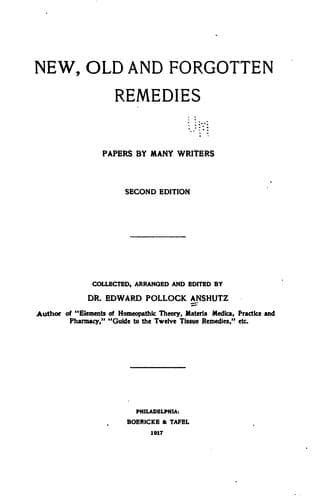
New, Old, and Forgotten Remedies: Papers by Many Writers
Science
New, Old, and Forgotten Remedies: Papers by Many Writers
Homeopathy -- Materia medica and therapeutics
Dr. Gillespie, of Edinburgh, "cured an obstinate intermittent with
cobweb after other means had failed." Dr. Robert Jackson was led from
this to try it himself. He told his success to Dr. Chapman, of
Philadelphia, who requested one of his pupils, Dr. Broughton, to
investigate the subject, which he did, and wrote his Inaugural Thesis
thereon in 1818. From these and other authorities we can gather enough
testimony to show that it is well worth while to make a systematic
proving of this animal product, thereby predicating its sphere and
precisioning its employment.
In a work on fevers--which particular edition I have not been able to
consult--Dr. Jackson writes: "I think I may venture to say that it
prevents the recurrence of febrile paroxysms more abruptly, and more
effectually, than bark or arsenic, or any other remedy employed for that
purpose with which I am acquainted: that, like all other remedies of
the kind, it is only effectual as applied under a certain condition of
habit; _but that the condition of susceptibility for cobweb is at the
same time of more latitude than for any other of the known remedies_."
If we bear in mind Grauvogl's constitution-classification of _Diadema
aranea_ as an hydrogenoid remedy, and recall how generally the
hydrogenoid constitution is induced by intermittent fever, we shall be
ready to acknowledge the truth of the passage which I have placed in
italics, and with this evidence of a truthful beginning we shall be more
ready to accept the subsequent testimony.
"If the cobweb," continues Dr. Jackson, "was given in the time of
perfect intermission, the return of paroxysm was prevented; if given
under the first symptoms of a commencing paroxysm, the symptoms were
suppressed, and the course of the paroxysm was so much interrupted that
the disease, for the most part, lost its characteristic symptoms. If it
was not given until the paroxysm was advanced in progress the symptoms
of irritation, viz.: tremors, startings, spasms, and delirium, if such
existed as forms of febrile action, were usually reduced in violence,
sometimes entirely removed. In this case sleep, calm and refreshing,
usually followed the sudden and perfect removal of pain and irritation.
Vomiting, spasms, and twisting in the bowels, appearing as modes of
febrile irritation, were also usually allayed by it; there was no effect
from it where the vomiting or pain was connected with real inflammation
or progress to disorganization."
"In cases of febrile depression, deficient animation, or indifference to
surrounding objects, the exhibition of eight or ten grains of cobweb was
often followed by exhilaration: the eyes sparkled; the countenance
assumed a temporary animation, and, though the course of the disease
might not be changed, or the danger averted, more respite was obtained
than is gotten from wine, opium, or anything else within my knowledge."
Public-domain text, read in full here on John Shaqi.
Reviews
Reviews
No reviews yet
Be the first to share your thoughts on this work.
Elsewhere in the archive
Join the Discussion
Join the discussion
Sign in to leave a comment or review.
Sign InorCreate an account