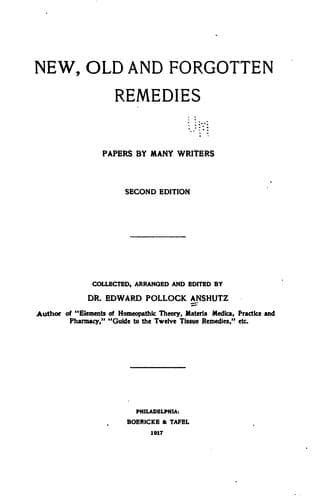
New, Old, and Forgotten Remedies: Papers by Many Writers
Science
New, Old, and Forgotten Remedies: Papers by Many Writers
Homeopathy -- Materia medica and therapeutics
According to Dioscorides, it is emmenagogue and abortive,
anti-hæmorrhagic, and a remedy for sciatica. In Salmon's _Doren Medicum_
(1683) it is said: "The seed provokes urine and the courses, kills the
_foetus_, resists poyson, breaks inward apostems, and, being taken in
[Latin: ezh]ij, it purges cholera." In Vogel's _Historia Materiæ Medicæ_
we read of the seed: "Ischiaticis infusum prodesse, et menses ciere
(Dioscorides). Sudorem pellere, et ad scorbutum posse, si eb vius
teratur, adiecto saccharo (Boerhaav)." It was called by the old
herbalists _sanguinaria_--"quia sanguinem sistet." Murray, at the end of
last century, pronounced it useless; but De Maza, arguing against this
opinion, relates a case of metrorrhagia cured by it, applied as a
cataplasm to the loins, on the recommendation of an old woman, after the
doctor had tried several medicines without effect. Lejeune (1822) says
he has seen good results from its employment in hæmoptysis.
Rademacher has a great opinion of it. He says: "This plant was held to
be an anti-hæmorrhagic medicine by the ancients. The superior wisdom of
later physicians has pronounced it to have no such power, _because it
contains no astringent principle_! (Carheuser's _Mat. Med._) A second
property attributed to it was that of stopping diarrhoea; a third,
that of cutting short agues. I have lately used it repeatedly in chronic
diarrhoea, when this is purely a primary affection of the bowels, with
surprising benefit; but it is useless in consensual diarrhoea. I have
not yet used it in ague, but would not dissuade others from trying it.
But the most important remedial power of this common innocuous plant I
learned from no medical author; the knowledge of it was actually forced
upon me by the following case: I was called to see a poor woman from
whom, eight or ten years before, I had brought away a large quantity of
urinary sand by means of magnesia and cochineal, and thereby cured her.
Now, the tiresome sand had again accumulated in the kidneys, and the
patient was in a pitiable state. The abdominal cavity was full of water,
the lower extremities swollen by oedema, and the urine of a bright red
color, which formed, on standing, a sediment unmistakably of blood. I
prescribed tincture of _Brusa pastoris_, 30 drops, 5 times a day, solely
with the intention of stopping the hæmaturia as a preliminary; but
imagine my astonishment when I found that the tincture caused a more
copious discharge of renal sand than I had ever witnessed. Paracelsus's
words occurred to me: 'A physician should overlook nothing; he should
look down before him like a maiden, and he will find at his feet a more
valuable treasure for all diseases than India, Egypt, Greece or Barbary
can furnish.' I should certainly have been a careless fool had I, with
this striking effect before me, changed to another medicine. I continued
to give the tincture; I saw the urinary secretion increase with the
Public-domain text, read in full here on John Shaqi.
Reviews
Reviews
No reviews yet
Be the first to share your thoughts on this work.
Elsewhere in the archive
Join the Discussion
Join the discussion
Sign in to leave a comment or review.
Sign InorCreate an account