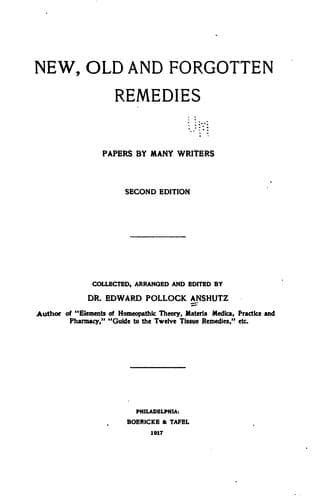
New, Old, and Forgotten Remedies: Papers by Many Writers
Science
New, Old, and Forgotten Remedies: Papers by Many Writers
Homeopathy -- Materia medica and therapeutics
Besides all these, I think individual idiosyncrasy has a great deal to
do. The season of the year has some influence. It is usually observed in
this country that those who are subject to periodical attacks of
asthmatic fits are more prone to an attack either during the full or the
new moon, or at both the times. I believe if it is properly watched this
fact will be evident all over the world. Same is true of some other
diseases, as chronic cough, chronic fevers, rheumatism, either acute or
chronic, gout, elephantiasis, other glandular enlargements, etc., get
aggravated or are prone to aggravation during such changes of the moon.
Then some people get more severe and frequent fits during the winter
than the summer and the others more during the summer than the winter.
Let me here tell you that the Indian summer is very different from
either the English or the American. Some part of the Indian summer
season is quite rainy and the atmosphere is saturated with moisture and
other irritating ingredients, consequently a class of asthmatic people
suffer more during this season. I noticed to this class of cases _Blatta
orientalis_ will prove most efficacious. I have used it in bronchial and
nervous asthma with better success than the stomachæ.
SECOND PAPER.
I have of late tried _Blatta orientalis_ indiscriminately in almost all
cases of asthma that have come under my treatment, and I am glad to say
I have received good results in most cases, as the reports of some of
the clinical cases will show. I have not come to any definite use of
this drug yet, but I shall only mention a few facts that I have observed
during its use. It acts better in low potency and repeated doses during
an attack of asthma; when the spasm subsides, the terminal asthmatic
cough with wheezing and slight dyspnoea, etc., is better relieved with
higher potencies; the low potency, if continued after the spasmodic
period is over, will make the cough more troublesome and harassing to
the patient and the expectoration tenacious, thick and very difficult to
raise, but this will not be the case if the potency is changed. I had
this difficulty in a few cases when I was less acquainted with the
action of the drug, but now I manage my cases better. In four patients
who continued the drug for some time in the low potency, during the
paroxysm and after it was over, the cough became dry and hacking with
little or no expectoration, the streaks of blood appeared in the sputa,
which the patients had never observed in the course of their long
illness. This appearance of blood in their sputa was the cause of a
great anxiety to them and made them hurry over to my office. On inquiry
I learned from two of them--one a lady and the other a young man--that
while taking this remedy they felt a sensation all over the body, for
four or five days previous to the appearance of the blood, as if heat
were radiating from the ears, eyes, nose, top of the head, palms of the
hands and soles of the feet.
Public-domain text, read in full here on John Shaqi.
Reviews
Reviews
No reviews yet
Be the first to share your thoughts on this work.
Elsewhere in the archive
Join the Discussion
Join the discussion
Sign in to leave a comment or review.
Sign InorCreate an account