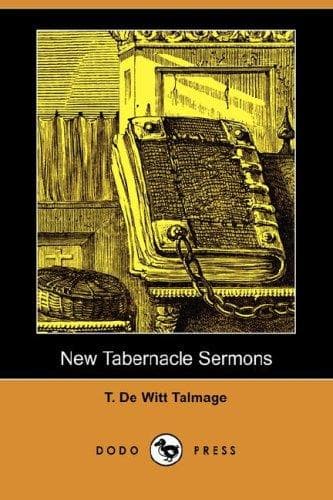
New Tabernacle SermonsTalmage, T. De Witt (Thomas De Witt)
Religion
New Tabernacle Sermons
Talmage, T. De Witt (Thomas De Witt)
Presbyterian Church -- Sermons; Sermons, American
II. Another temptation around nearly all our watering-places is the
horse-racing business. We all admire the horse. There needs to be a
redistribution of coronets among the brute creation. For ages the lion
has been called the king of beasts. I knock off its coronet and put
the crown upon the horse, in every way nobler, whether in shape or
spirit or sagacity or intelligence or affection or usefulness. He is
semi-human, and knows how to reason on a small scale. The centaur of
olden times, part horse and part man, seems to be a suggestion of the
fact that the horse is something more than a beast.
Job sets forth his strength, his beauty, his majesty, the panting of
his nostril, the pawing of his hoof, and his enthusiasm for the
battle. What Rosa Bonheur did for the cattle, and what Landseer did
for the dog, Job, with mightier pencil, does for the horse.
Eighty-eight times does the Bible speak of him. He comes into every
kingly procession and into every great occasion and into every
triumph. It is very evident that Job and David and Isaiah and Ezekiel
and Jeremiah and John were fond of the horse. He came into much of
their imagery. A red horse--that meant war; a black horse--that meant
famine; a pale horse--that meant death; a white horse--that meant
victory.
As the Bible makes a favorite of the horse, the patriarch and the
prophet and the evangelist and the apostle, stroking his sleek hide,
and patting his rounded neck, and tenderly lifting his exquisitely
formed hoof, and listening with a thrill to the champ of his bit, so
all great natures in all ages have spoken of him in encomiastic terms.
Virgil in his Georgics almost seems to plagiarize from the description
of Job. The Duke of Wellington would not allow any one irreverently to
touch his old war-horse, Copenhagen, on whom he had ridden fifteen
hours without dismounting at Waterloo; and when old Copenhagen died,
his master ordered a military salute fired over his grave. John
Howard showed that he did not exhaust all his sympathies in pitying
the human race, for when sick he writes home: "Has my old chaise-horse
become sick or spoiled?"
But we do not think that the speed of the horse should be cultured at
the expense of human degradation. Horse-races, in olden times, were
under the ban of Christian people, and in our day the same institution
has come up under fictitious names, and it is called a "Summer
Meeting," almost suggestive of positive religious exercises. And it is
called an "Agricultural Fair," suggestive of everything that is
improving in the art of farming. But under these deceptive titles are
the same cheating and the same betting, the same drunkenness and the
same vagabondage and the same abominations that were to be found under
the old horse-racing system.
Public-domain text, read in full here on John Shaqi.
Reviews
Reviews
No reviews yet
Be the first to share your thoughts on this work.
Elsewhere in the archive
Join the Discussion
Join the discussion
Sign in to leave a comment or review.
Sign InorCreate an account