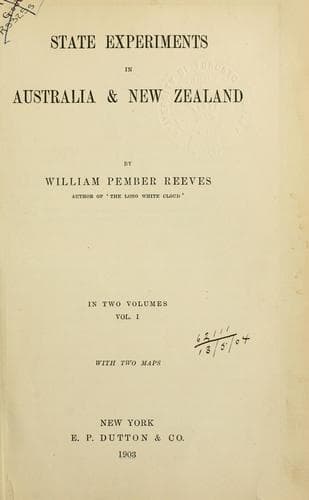
New Zealand -- Description and travel; New Zealand -- History
foil to the wonders of Nature, the toil is healthy for the men as well
as useful to the country. From the vast extent of the pumice and clay
layers it would seem that, uneasy as the thermal territory now is, it
has, for all its geysers, steaming cones, and innumerable springs,
become but a fretful display of slowly dying forces. So say those who
look upon the great catastrophe of 1886 as merely the flicker of a
dying flame.
[Illustration: HUKA FALLS]
As already said, the volcanic zone is a land of lakes, many and
beautiful. Four of the most interesting--Roto-rua, Roto-iti, Roto-ehu,
and Roto-ma--lie in a chain, like pieces of silver loosely strung
together. South of these Tarawera sleeps in sight of its terrible
mountain, and south again of Tarawera the hot springs of Roto-mahana
still draw sight-seers, though its renowned terraces are no longer
there. Lake Okataina is near, resting amid unspoiled forest: and there
is Roto-kakahi, the green lake, and, hard by, Tikitapu, the blue lake,
beautiful by contrast. But, of course, among all the waters Taupo
easily overpeers the rest. “The Sea” the Maori call it; and indeed
it is so large, and its whole expanse so easily viewed at once from
many heights, that it may well be taken to be greater than it is. It
covers 242 square miles, but the first white travellers who saw it and
wrote about it guessed it to be between three and five hundred. Hold
a fair-sized map of the district with the eastern side uppermost and
you will note that the shape of Taupo is that of an ass’s head with
the ears laid back. This may seem an irreverent simile for the great
crater lake, with its deep waters and frowning cliffs, held so sacred
and mysterious by the Maori of old. Seldom is its surface flecked by
any sail, and only one island of any size breaks the wide expanse. The
glory of Taupo--apart from the noble view of the volcanoes southward
of it--is a long rampart of cliffs that almost without a break hems
in its western side mile after mile. At their highest they reach 1100
feet. So steep are they that in flood-time cascades will make a clean
leap from their summits into the lake; and the sheer descent of the
wall continues below the surface, for, within a boat’s length of the
overhanging cliff, sounding-leads have gone down 400 feet. Many are
the waterfalls which in the stormier months of the year seam the rocky
faces with white thread-like courses. On a finer scale than the others
are the falls called Mokau, which, dashing through a leafy cleft, pour
into the deep with a sounding plunge, and, even from a distance, look
something broader and stronger than the usual white riband.
Public-domain text, read in full here on John Shaqi.
Reviews
Reviews
No reviews yet
Be the first to share your thoughts on this work.
Elsewhere in the archive
Join the Discussion
Join the discussion
Sign in to leave a comment or review.
Sign InorCreate an account