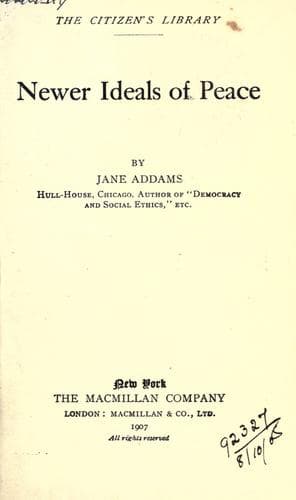
Municipal government -- United States; Peace; Political participation -- United States; Social justice; Working class -- United States
It is really human constructive labor which must give the newly invaded
country a sense of its place in the life of the civilized world, some
idea of the effective occupations which it may perform. In order to
accomplish this its energy must be freed and its resources developed.
Militarism undertakes to set in order, to suppress and to govern, if
necessary to destroy, while industrialism undertakes to liberate latent
forces, to reconcile them to new conditions, to demonstrate that their
aroused activities can no longer follow caprice, but must fit into a
larger order of life. To call this latter undertaking, demanding ever
new powers of insight, patience, and fortitude, less difficult, less
manly, less strenuous, than the first, is on the face of it absurd.
It is the soldier who is inadequate to the difficult task, who strews
his ways with blunders and lost opportunities, who cannot justify his
vocation by the results, and who is obliged to plead guilty to a lack
of rational method.
Of British government in the Empire, an Englishman has recently
written, “We are obliged in practise to make a choice between good
order and justice administered autocratically in accordance with
British standards on the one hand, and delicate, costly, doubtful,
and disorderly experiments in self-government on British lines upon
the other, and we have practically everywhere decided upon the former
alternative. It is, of course, less difficult.”[16] Had our American
ideals of patriotism and morality in international relations kept
pace with our experience, had we followed up our wide commercial
relations with an adequate ethical code, we can imagine a body of
young Americans, “the flower of our youth,” as we like to say,
proudly declining commercial advantages founded upon forced military
occupation and informing their well-meaning government that they
declined to accept openings on any such terms as these, that their
ideals of patriotism and of genuine government demanded the play of
their moral prowess and their constructive intelligence. Certainly in
America we have a chance to employ something more active and virile,
more inventive, more in line with our temperament and tradition, than
the mere desire to increase commercial relations by armed occupation
as other governments have done. A different conduct is required
from a democracy than from the mere order-keeping, bridge-building,
tax-gathering Roman, or from the conscientious Briton carrying the
blessings of an established government and enlarged commerce to all
quarters of the globe.
Public-domain text, read in full here on John Shaqi.
Reviews
Reviews
No reviews yet
Be the first to share your thoughts on this work.
Elsewhere in the archive
Join the Discussion
Join the discussion
Sign in to leave a comment or review.
Sign InorCreate an account