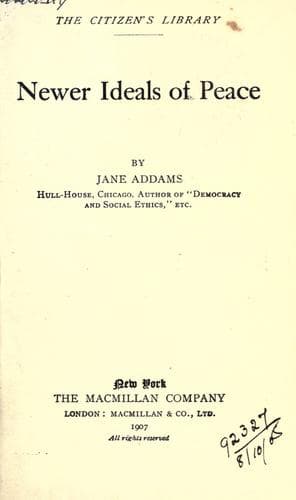
Municipal government -- United States; Peace; Political participation -- United States; Social justice; Working class -- United States
The Doukhobors are a religious sect in Russia whose creed emphasizes
the teaching of non-resistance. A story is told of one of their young
men who, because of his refusal to enter the Russian army, was brought
for trial before a judge, who reasoned with him concerning the folly
of his course and in return received a homily upon the teachings of
Jesus. “Quite right you are,” answered the judge, “from the point of
abstract virtue, but the time has not yet come to put into practise the
literal sayings of Christ.” “The time may not have come for you, your
Honor,” was the reply, “but the time has come for us.” Who can tell at
what hour vast numbers of Russian peasants upon those Russian steppes
will decide that the time has come for them to renounce warfare, even
as their prototype, the mujik, Count Tolstoy, has already decided that
it has come for him? Conscious as the peasants are of religious motive,
they will meet a cheerful martyrdom for their convictions, as so many
of the Doukhobors have done. It may, however, be easy to overestimate
this changed temper because of the simple yet dramatic formulation
given by Tolstoy to the non-resisting spirit. How far Tolstoy is really
the mouthpiece of a great moral change going on in the life of the
Russian peasant and how far he speaks merely for himself, it is, of
course, impossible to state. If only a few peasants are experiencing
this change, his genius has certainly done much to make their position
definite. The man who assumes that a new degree of virtue is possible,
thereby makes it real and tangible to those who long to possess it but
lack courage. Tolstoy at least is ready to predict that in the great
affairs of national disarmament, it may easily be true that the Russian
peasants will take the first steps.
Their armed rebellion may easily be overcome by armed troops, but what
can be done with their permanent patience, their insatiable hunger
for holiness? All idealism has its prudential aspects, and, as has
been pointed out by Mr. Perris,[17] no other form of revolution is so
fitted to an agricultural people as this continued outburst of passive
resistance among whole communities, not in theory, but in practise.
This peasant movement goes on in spite of persecution, perfectly
spontaneous, self-reliant, colossal in the silent confidence and power
of endurance. In this day of Maxim guns and high explosives, the old
method of revolt would be impossible to an agricultural people, but
the non-resistant strike against military service lies directly in
line with the temperament and capacity of the Russian people. That
“the government cannot put the whole population in prison, and, if it
could, it would still be without material for an army, and without
money for its support,” is an almost irrefutable argument. We see here,
at least, the beginnings of a sentiment that shall, if sufficiently
developed, make war impossible to an entire people, a conviction of sin
manifesting itself throughout a nation.
Public-domain text, read in full here on John Shaqi.
Reviews
Reviews
No reviews yet
Be the first to share your thoughts on this work.
Elsewhere in the archive
Join the Discussion
Join the discussion
Sign in to leave a comment or review.
Sign InorCreate an account