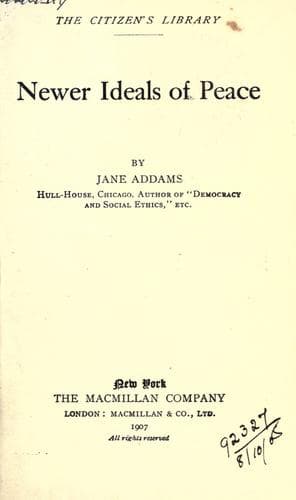
Municipal government -- United States; Peace; Political participation -- United States; Social justice; Working class -- United States
“Miss Addams is clear. She has not been precipitate in the preparation
of her book. She has reconsidered, corrected, and recorrected it,
spoken with temperance and courtesy.... As gentle, as patient, as
sincere, and as astute as Jane Addams herself is the philosophy set
forth in these pages.... The processes of Miss Addams’ thought are
interesting to thousands. The sense that none of us is living up to
the best idea of democracy is upon each of us.... Miss Addams is
bound to receive a respectful hearing. As a leader who ever prays to
lead aright, a sociologist who is willing to test her theories in a
practical and personal way, a theorist who is not ashamed to own when
she has been mistaken, a friend who will remain true to her friend no
matter what may arise, and a person of leisure and power, who has the
civic interest at heart, she has come to be prized as one of the chief
of citizens.”--_Chicago Tribune._
“Its pages are remarkably--we were about to say refreshingly--free
from the customary academic limitations.... In fact, are the result
of actual experience in hand to hand contact with social problems....
No more truthful description, for example, of the political ‘boss’ as
he thrives to-day in our great cities has ever been written than is
contained in Miss Addams’ chapter on ‘Political Reform.’ The whole
chapter will be accepted as a realistic picture of conditions as they
are to-day in the city of Chicago. The same thing may be said of the
other chapters of the book in regard to their presentation of social
and economic facts.”--_Review of Reviews._
“Too much emphasis cannot be laid upon the efficiency and inspiration
afforded by these essays. ‘Charitable Effort,’ ‘Filial Affections,’
‘Household Adjustment,’ ‘Industrial Amelioration,’ ‘Educational
Methods,’ ‘Political Reform,’ are the topics treated in a masterly and
revolutionary style. Miss Addams shatters some of our most cherished
illusions upon the relations which should exist between the helper and
the helped, between parent and child, mistress and maid, the members
of a family, between the ‘boss’ and the community. She takes the
subject entirely out of the realms of sentimentality, puts it upon
a solid moral basis, and by a close and logical train of reasoning
brings her conclusions home to the conscience and common sense of every
member of the social structure. The book is startling, stimulating and
intelligent.”--_Philadelphia Ledger._
The Arbiter in Council
A discussion of peace and war, in which take part, each from his own
viewpoint, a lawyer “with a conscience,” a stock broker, a learned
professor of history, a journalist, a retired admiral, an army officer,
and two clergymen of widely differing forms of church government. The
Arbiter is a veteran student of politics, a disciple of John Bright.
Public-domain text, read in full here on John Shaqi.
Reviews
Reviews
No reviews yet
Be the first to share your thoughts on this work.
Elsewhere in the archive
Join the Discussion
Join the discussion
Sign in to leave a comment or review.
Sign InorCreate an account