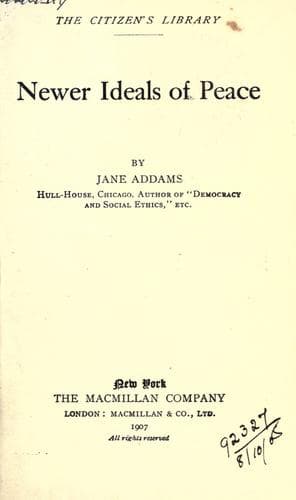
Municipal government -- United States; Peace; Political participation -- United States; Social justice; Working class -- United States
The movements embodying a new idealism have traditionally sought refuge
with those who are near to starvation. Although the spiritual struggle
is associated with the solitary garret of the impassioned dreamer,
it may be that the idealism fitted to our industrial democracy will
be evolved in crowded sewer ditches and in noisy factories. It may
be contended that this remarkable coming together of the workingman
and the immigrant has been the result of an economic pressure, and is
without merit or idealism, and that the trades union record on Chinese
exclusion and negro discrimination has been damaging. Be that as it
may, this assimilation between the immigrant and the workingman has
exhibited amazing strength, which may be illustrated from two careful
studies made in two different parts of the country.
To quote first from a study made from the University of Wisconsin
of the stock yards strike which took place in Chicago in 1904[6]:
“Perhaps the fact of the greatest social significance is that this
was not merely a strike of skilled labor for the unskilled, but was
a strike of Americanized Irish, Germans, and Bohemians, in behalf of
Slovaks, Poles, and Lithuanians.... This substitution of races in the
stock yards has been a continuing process for twenty years. The older
nationalities have already disappeared from the unskilled occupations,
and the substitution of races has evidently run along the line of
lower standard of living. The latest arrivals, the Lithuanians and
Slovaks, are probably the most oppressed of the peasants of Europe.”
The visitors who attended the crowded meetings of the strikers during
the summer of 1904 and heard the same address successively translated
by interpreters into six or eight languages, who saw the respect
shown to the most uncouth of the speakers by the skilled American men
representing a distinctly superior standard of life and thought, could
never doubt the power of the labor organizations for amalgamation,
whatever opinion they might hold concerning their other values. This
may be said in spite of the fact that great industrial disturbances
have arisen from the under-cutting of wages by the lowering of racial
standard. Certainly the most notable of these have taken place in those
industries and at those places in which the importation of immigrants
has been deliberately fostered as a wage-lowering weapon; and even in
those disturbances and under the shock and strain of a long strike,
disintegration did not come along the line of race cleavage.
Public-domain text, read in full here on John Shaqi.
Reviews
Reviews
No reviews yet
Be the first to share your thoughts on this work.
Elsewhere in the archive
Join the Discussion
Join the discussion
Sign in to leave a comment or review.
Sign InorCreate an account