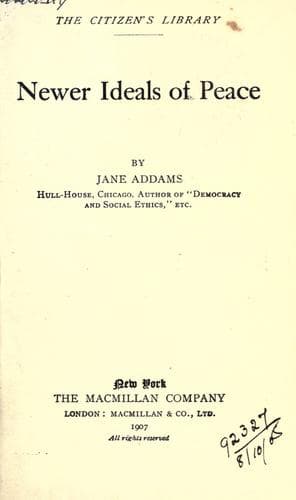
Municipal government -- United States; Peace; Political participation -- United States; Social justice; Working class -- United States
The other study was made in the anthracite coal fields, and was
undertaken from the University of Pennsylvania[7]: “The United
Mine Workers of America is taking men of a score of nationalities,
English-speaking and Slav, men of widely different creeds, languages,
and customs, and of varying powers of industrial competition, and is
welding them into an industrial brotherhood, each part of which can
at least understand of the others that they are working for one great
and common end. This bond of unionism is stronger than one can readily
imagine who has not seen its mysterious workings or who has not been
a victim of its members’ newly found enthusiasm. It is to-day the
strongest tie that can bind together 147,000 mine workers and the
thousands dependent upon them. It is more than religion, more than the
social ties which hold together members of the same community.”
It was during a remarkable struggle on the part of this amalgamation
of men from all countries, that the United States government, in spite
of itself, was driven to take a hand in an industrial situation,
owing to the long strain and the intolerable suffering entailed upon
the whole country. Even then, however, the Government endeavored to
confine its investigation to the mere commercial questions of tonnage
and freight rates with their political implications, and it was only
when an aroused and moralized public opinion insisted upon it that
the national commission was driven to consider the human aspects of
the case. Because of this public opinion, columns of newspapers and
days of investigation were given to the discussion of the deeds of
violence, discussions having nothing to do with the original demands
of the strikers and entering only into the value set upon human life
by each of the contesting parties. Did the union encourage violence
against non-union men, or did it really do everything to suppress
violence? Did it live up to its creed which was to maintain a standard
of living that families might be properly housed and protected from
debilitating toil and disease, and that children might be nurtured into
American citizenship? Did the operators protect their men as far as
possible from mine damp, from length of hours proven by experience to
be exhausting? Did they pay a wage to the mine laborer sufficient to
allow him to send his children to school? Questions such as these, a
study of the human problem, invaded the commission day after day during
the sitting. One felt for the moment the first wave of a rising tide
of humanitarianism, until the normal ideals of the laborer to secure
food and shelter for his family, a security for his own old age, and
a larger opportunity for his children became the ideals of democratic
government.
Public-domain text, read in full here on John Shaqi.
Reviews
Reviews
No reviews yet
Be the first to share your thoughts on this work.
Elsewhere in the archive
Join the Discussion
Join the discussion
Sign in to leave a comment or review.
Sign InorCreate an account