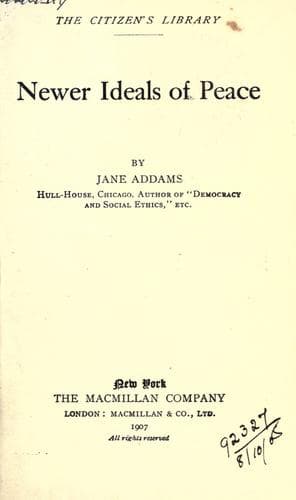
Municipal government -- United States; Peace; Political participation -- United States; Social justice; Working class -- United States
The strike involved much suffering and many unforeseen complications.
At the end of eight weeks the union leaders made the best terms
possible. Through these terms the skilled workers were guaranteed
against a reduction in wages, but no provision was made for the
unskilled in whose behalf the strike had at first been undertaken.
Although the hard-pressed leaders were willing to make this concession,
the politicians in the meanwhile had seen the great value of the human
sentiment which bases its appeal on the need of the under dog and which
had successfully united this mass of workingmen into a new comradeship
with the immigrants. The appeal was infinitely more valuable than any
merely political cry, and the fact that the final terms of settlement
were submitted to a referendum vote at once gave the local politicians
a chance to avail themselves of this big, loosely defined sympathy.
They did avail themselves of this in so dramatic a manner that they
almost succeeded, solely upon that appeal, in taking the strike out of
the hands of the legitimate officers and placing it in their own hands
for their own political ends.
The situation was a typical one, exemplifying the real aim of popular
government with its concern for primitive needs, forced to seek
expression outside of the organized channels of government. If the
militia could have been called in, government would have been placed
even more dramatically in the position of the oppressor of popular
self-government. The phenomenal good order, the comparative lack of
violence on the part of the striking workmen, gave no chance for the
bringing in of the militia. The city politician was of course very much
disappointed, for it would have afforded him an opening to put the
odium of this traditional opposition of government, an opposition which
has always been most dramatically embodied in the soldier, upon the
political party dominating the State but not the city. It would have
given the city politician an excellent opportunity to show the concern
of himself and his party for the real people, as over against the
attitude of the party dominating the State. But because the militia was
not called, his scheme failed, and the legitimate strike leaders who,
although they passed through much tribulation because of this political
interference, did not eventually lose control.
The situation in the Chicago stock-yards also afforded an excellent
epitome of the fact that government so often finds itself, not only in
opposition to the expressed will of the people making the demand at the
moment, but apparently against the best instincts of the mass of the
citizens as a whole.
Public-domain text, read in full here on John Shaqi.
Reviews
Reviews
No reviews yet
Be the first to share your thoughts on this work.
Elsewhere in the archive
Join the Discussion
Join the discussion
Sign in to leave a comment or review.
Sign InorCreate an account