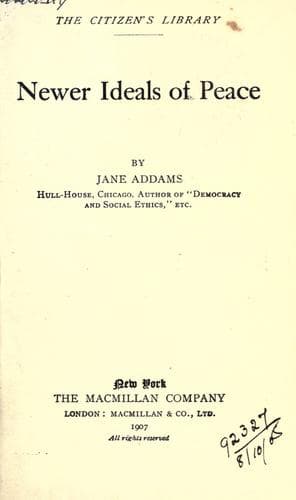
Municipal government -- United States; Peace; Political participation -- United States; Social justice; Working class -- United States
To preserve law and order is obviously the function of government
everywhere; and yet in our complicated modern society, especially as
thousands of varied peoples are crowded into cities, it is not always
easy to see just where real social order lies. The officials themselves
are sometimes perplexed, and at other times deliberately use the
devices of government for their own ends. We may take once more in
illustration the great strike in the Chicago stock-yards. The immediate
object of the strike was the protection of the wages of the unskilled
men from a cut of one cent per hour, although, of course, the unions
of skilled men felt that this first invasion of the wages increased
through the efforts of the union, would be but the entering wedge of an
attempt to cut wages in all the trades represented in the stock-yards.
Owing to the refusal on the part of the unions to accept arbitration
offered by the packers at an embarrassing moment, and because of the
failure of the unions to carry out the terms of a contract, the strike
in its early stages completely lost the sympathy of that large part of
the public dominated by ideals of business honor and fair dealing. It
lost, too, the sympathy of that growing body of organized labor which
is steadily advancing in a regard for the validity of the contract, and
is faithfully cherishing the hope that in time the trades unions may
universally attain an accredited business standing.
The leaders after the first ten days were, therefore, forced to
make the most of the purely human appeal which lay in the situation
itself, that 30,000 men, including the allied trades, were losing
weeks of wages, with a possible chance of the destruction of their
unions on behalf of the unskilled who were the newly arrived Poles
and Lithuanians, unable as yet to look out for themselves. Owing
to the irregular and limited hours of work--a condition quite like
that prevailing on the London docks before the great strike of the
dockers--the weekly wage of these unskilled men was exceptionally low,
and the plea of the strikers was based upon the duty of the strong
to the weak. A chivalric call was issued that the standard of life
might be raised to that designated as American, and that this mass of
unskilled men might secure an education for their children. Of course
no appeal could have been so strong as this purely human one which
united for weeks thousands of men of a score of nationalities into that
solidarity which only comes through a self-sacrificing devotion to an
absorbing cause.
Public-domain text, read in full here on John Shaqi.
Reviews
Reviews
No reviews yet
Be the first to share your thoughts on this work.
Elsewhere in the archive
Join the Discussion
Join the discussion
Sign in to leave a comment or review.
Sign InorCreate an account