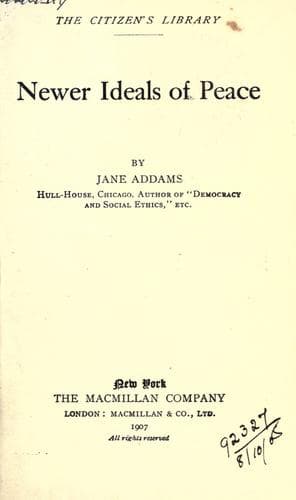
Municipal government -- United States; Peace; Political participation -- United States; Social justice; Working class -- United States
labor movement.
We must first get down to the question, In what does “the inevitably
destined rise of the men of labor” consist? What are we trying to
solve in this “most hazardous problem of the age”? Is progress in the
labor movement to come, as we are told progress comes in the non-moral
world, by the blind, brute struggle of individual interests; or is it
to come, as its earlier leaders believed, through the operation of the
human will? Is it a question of morals which must depend upon educators
and apostles; or is it merely a conflict of opposing rights which may
legitimately use coercion? The question, from the very nature of the
case, is confusing; for, of necessity, the labor movement has perfectly
legitimate economic and business aspects, which loom large and easily
overshadow the ethical. We would all agree that only when men have
education, a margin of leisure, and a decent home can they find room to
develop the moral life. Before that, there are too many chances that
it will be crushed out by ignorance, by grinding weariness, and by
indecency. But the danger lies in the conviction that these advantages
are to be secured by any means, moral or non-moral, and in holding them
paramount to the inner life which they are supposed to nourish. The
labor movement is confronted by that inevitable problem which confronts
every movement and every individual. How far shall the compromise be
made between the inner concept and the outer act? How may we concede
what it is necessary to concede, without conceding all?
We constantly forget that, in the last analysis, the spiritual growth
of one social group is conditioned by the reaction of other social
groups upon it. We ignore the fact that the worship of success, so long
dominant in America, has taught the majority of our citizens to count
only accomplishment and to make little inquiry concerning methods.
Success has become the sole standard in regard to business enterprises
and political parties, but it is evident that the public intends to
call a halt before it is willing to apply the same standard to labor
organizations.
It is clear that the present moment is one of unusual crisis--that many
of the trades unions of America have reached a transitional period,
when they can no longer be mere propagandists, but are called upon to
deal with concrete and difficult situations. When they were small and
persecuted, they held to the faith and its implication of idealism. As
they become larger and more powerful, they make terms with the life
about them, and compromise as best they may with actual conditions.
Public-domain text, read in full here on John Shaqi.
Reviews
Reviews
No reviews yet
Be the first to share your thoughts on this work.
Elsewhere in the archive
Join the Discussion
Join the discussion
Sign in to leave a comment or review.
Sign InorCreate an account