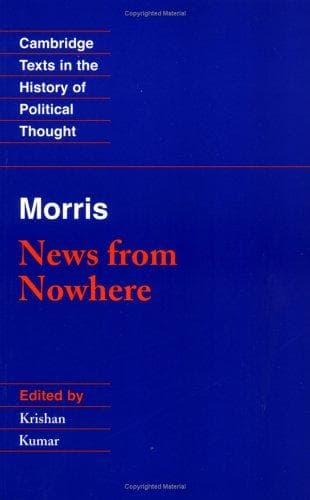
News from Nowhere; Or, An Epoch of Rest: Being Some Chapters from a Utopian RomanceMorris, William
Science
News from Nowhere; Or, An Epoch of Rest: Being Some Chapters from a Utopian Romance
Morris, William
Utopias
"Yes," she said; and it seemed to me as if a slight cloud came over her
fair face. I was going to speak to her on the subject, when the pretty
waitresses came to us smiling, and chattering sweetly like reed warblers
by the river side, and fell to giving us our dinner. As to this, as at
our breakfast, everything was cooked and served with a daintiness which
showed that those who had prepared it were interested in it; but there
was no excess either of quantity or of gourmandise; everything was
simple, though so excellent of its kind; and it was made clear to us that
this was no feast, only an ordinary meal. The glass, crockery, and plate
were very beautiful to my eyes, used to the study of mediaeval art; but a
nineteenth-century club-haunter would, I daresay, have found them rough
and lacking in finish; the crockery being lead-glazed pot-ware, though
beautifully ornamented; the only porcelain being here and there a piece
of old oriental ware. The glass, again, though elegant and quaint, and
very varied in form, was somewhat bubbled and hornier in texture than the
commercial articles of the nineteenth century. The furniture and general
fittings of the hall were much of a piece with the table-gear, beautiful
in form and highly ornamented, but without the commercial "finish" of the
joiners and cabinet-makers of our time. Withal, there was a total
absence of what the nineteenth century calls "comfort"--that is, stuffy
inconvenience; so that, even apart from the delightful excitement of the
day, I had never eaten my dinner so pleasantly before.
When we had done eating, and were sitting a little while, with a bottle
of very good Bordeaux wine before us, Clara came back to the question of
the subject-matter of the pictures, as though it had troubled her.
She looked up at them, and said: "How is it that though we are so
interested with our life for the most part, yet when people take to
writing poems or painting pictures they seldom deal with our modern life,
or if they do, take good care to make their poems or pictures unlike that
life? Are we not good enough to paint ourselves? How is it that we find
the dreadful times of the past so interesting to us--in pictures and
poetry?"
Old Hammond smiled. "It always was so, and I suppose always will be,"
said he, "however it may be explained. It is true that in the nineteenth
century, when there was so little art and so much talk about it, there
was a theory that art and imaginative literature ought to deal with
contemporary life; but they never did so; for, if there was any pretence
of it, the author always took care (as Clara hinted just now) to
disguise, or exaggerate, or idealise, and in some way or another make it
strange; so that, for all the verisimilitude there was, he might just as
well have dealt with the times of the Pharaohs."
Public-domain text, read in full here on John Shaqi.
Reviews
Reviews
No reviews yet
Be the first to share your thoughts on this work.
Elsewhere in the archive
Join the Discussion
Join the discussion
Sign in to leave a comment or review.
Sign InorCreate an account