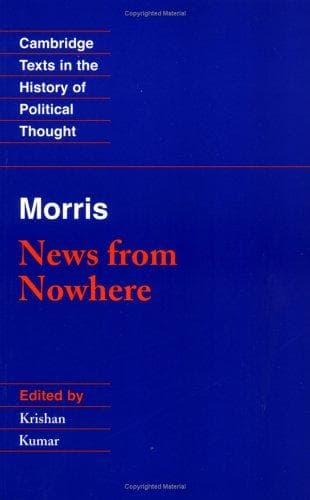
News from Nowhere; Or, An Epoch of Rest: Being Some Chapters from a Utopian RomanceMorris, William
Science
News from Nowhere; Or, An Epoch of Rest: Being Some Chapters from a Utopian Romance
Morris, William
Utopias
"Does anything especially puzzle you about our way of living, now you
have heard a good deal and seen a little of it?"
Said I: "I think what puzzles me most is how it all came about."
"It well may," said he, "so great as the change is. It would be
difficult indeed to tell you the whole story, perhaps impossible:
knowledge, discontent, treachery, disappointment, ruin, misery,
despair--those who worked for the change because they could see further
than other people went through all these phases of suffering; and
doubtless all the time the most of men looked on, not knowing what was
doing, thinking it all a matter of course, like the rising and setting of
the sun--and indeed it was so."
"Tell me one thing, if you can," said I. "Did the change, the
'revolution' it used to be called, come peacefully?"
"Peacefully?" said he; "what peace was there amongst those poor confused
wretches of the nineteenth century? It was war from beginning to end:
bitter war, till hope and pleasure put an end to it."
"Do you mean actual fighting with weapons?" said I, "or the strikes and
lock-outs and starvation of which we have heard?"
"Both, both," he said. "As a matter of fact, the history of the terrible
period of transition from commercial slavery to freedom may thus be
summarised. When the hope of realising a communal condition of life for
all men arose, quite late in the nineteenth century, the power of the
middle classes, the then tyrants of society, was so enormous and
crushing, that to almost all men, even those who had, you may say despite
themselves, despite their reason and judgment, conceived such hopes, it
seemed a dream. So much was this the case that some of those more
enlightened men who were then called Socialists, although they well knew,
and even stated in public, that the only reasonable condition of Society
was that of pure Communism (such as you now see around you), yet shrunk
from what seemed to them the barren task of preaching the realisation of
a happy dream. Looking back now, we can see that the great motive-power
of the change was a longing for freedom and equality, akin if you please
to the unreasonable passion of the lover; a sickness of heart that
rejected with loathing the aimless solitary life of the well-to-do
educated man of that time: phrases, my dear friend, which have lost their
meaning to us of the present day; so far removed we are from the dreadful
facts which they represent.
Public-domain text, read in full here on John Shaqi.
Reviews
Reviews
No reviews yet
Be the first to share your thoughts on this work.
Elsewhere in the archive
Join the Discussion
Join the discussion
Sign in to leave a comment or review.
Sign InorCreate an account