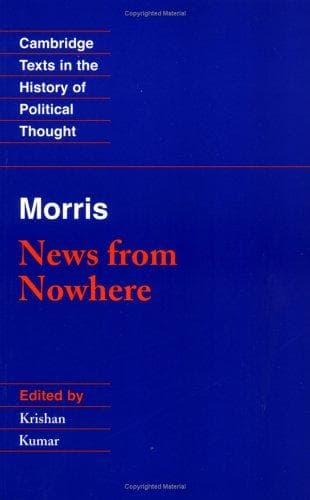
News from Nowhere; Or, An Epoch of Rest: Being Some Chapters from a Utopian RomanceMorris, William
Science
News from Nowhere; Or, An Epoch of Rest: Being Some Chapters from a Utopian Romance
Morris, William
Utopias
Said Hammond: "The Government lost no time in coming to terms with the
Committee of Public Safety; for indeed they could think of nothing else
than the danger of the moment. They sent a duly accredited envoy to
treat with these men, who somehow had obtained dominion over people's
minds, while the formal rulers had no hold except over their bodies.
There is no need at present to go into the details of the truce (for such
it was) between these high contracting parties, the Government of the
empire of Great Britain and a handful of working-men (as they were called
in scorn in those days), amongst whom, indeed, were some very capable and
'square-headed' persons, though, as aforesaid, the abler men were not
then the recognised leaders. The upshot of it was that all the definite
claims of the people had to be granted. We can now see that most of
these claims were of themselves not worth either demanding or resisting;
but they were looked on at that time as most important, and they were at
least tokens of revolt against the miserable system of life which was
then beginning to tumble to pieces. One claim, however, was of the
utmost immediate importance, and this the Government tried hard to evade;
but as they were not dealing with fools, they had to yield at last. This
was the claim of recognition and formal status for the Committee of
Public Safety, and all the associations which it fostered under its wing.
This it is clear meant two things: first, amnesty for 'the rebels,' great
and small, who, without a distinct act of civil war, could no longer be
attacked; and next, a continuance of the organised revolution. Only one
point the Government could gain, and that was a name. The dreadful
revolutionary title was dropped, and the body, with its branches, acted
under the respectable name of the 'Board of Conciliation and its local
offices.' Carrying this name, it became the leader of the people in the
civil war which soon followed."
"O," said I, somewhat startled, "so the civil war went on, in spite of
all that had happened?"
"So it was," said he. "In fact, it was this very legal recognition which
made the civil war possible in the ordinary sense of war; it took the
struggle out of the element of mere massacres on one side, and endurance
plus strikes on the other."
"And can you tell me in what kind of way the war was carried on?" said I.
Public-domain text, read in full here on John Shaqi.
Reviews
Reviews
No reviews yet
Be the first to share your thoughts on this work.
Elsewhere in the archive
Join the Discussion
Join the discussion
Sign in to leave a comment or review.
Sign InorCreate an account