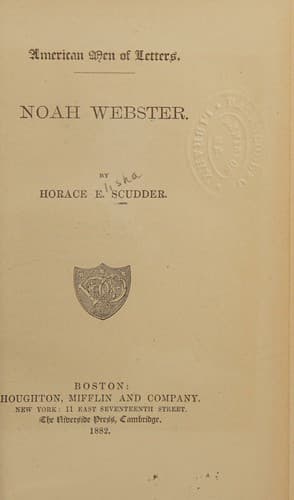
Noah Webster: American Men of LettersScudder, Horace Elisha
History
Noah Webster: American Men of Letters
Scudder, Horace Elisha
Educators -- United States -- Biography; Lexicographers -- United States -- Biography; Webster, Noah, 1758-1843
He was satisfied that he should work to better advantage in England. He
went accordingly to Cambridge in the early fall of 1824, and remained
there until the following May, using the resources of the University,
and making such connections as he could, though he found rather barren
sympathy from English scholars, and small encouragement from English
publishers. His training and studies, moreover, were not such as to
place him in very cordial relationship with Englishmen, and his attitude
toward the scholastic deposit of an old nation may be guessed from a
passage in one of his letters home, in which he writes: "The colleges
are mostly old stone buildings, which look very heavy, cold, and gloomy
to an American accustomed to the new public buildings in our country."
There is something in the whole undertaking, and in the mode of its
execution, which makes one by turns wonder at the splendid will and
undaunted perseverance of this Yankee teacher, and feel a well-bred
annoyance at his blindness to the incongruous position which he
occupied. One is disposed to laugh sardonically over this self-taught
dictionary-maker, encamped at Cambridge, coolly pursuing his work of an
American Dictionary of the English Language in the midst of all that
traditional scholarship. But Webster's own consciousness was of the
gravity of his work. "When I finished my copy," he writes in a letter to
Dr. Thomas Miner, "I was sitting at my table in Cambridge, England,
January, 1825. When I arrived at the last word I was seized with a
tremor that made it difficult to proceed. I, however, summoned up
strength to finish the work, and then, walking about the room, I soon
recovered." This may be a faint echo of Gibbon's celebrated passage, but
it is inherently truthful, and marks the effect upon him of a sustained
purpose, brought, after a score of years, to completion. The Dictionary
was published three years after his return to America, and passed
through one revision at Mr. Webster's hands in 1840. He was still at
work upon it when he died, in 1843. It is fair to look to the preface of
a great work, especially of one which seems to admit little personality,
for an account of the motives and aims of the workman. In following the
lines of Webster's preface we discover the principles which we have
already noted stated anew and with increasing confidence. He gives
reasons why it had become necessary that an English dictionary should be
revised to meet the exigencies of American as distinct from English
life, and he says finally: "One consideration, however, which is
dictated by my own feelings, but which I trust will meet with
approbation in correspondent feelings in my fellow-citizens, ought not
to be passed in silence; it is this: 'The chief glory of a nation,' says
Dr. Johnson, 'arises from its authors.' With this opinion deeply
impressed on my mind, I have the same ambition which actuated that great
man when he expressed a wish to give celebrity to Bacon, to Hooker, to
Public-domain text, read in full here on John Shaqi.
Reviews
Reviews
No reviews yet
Be the first to share your thoughts on this work.
Elsewhere in the archive
Join the Discussion
Join the discussion
Sign in to leave a comment or review.
Sign InorCreate an account