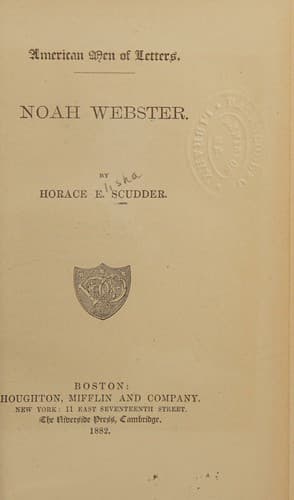
Noah Webster: American Men of LettersScudder, Horace Elisha
History
Noah Webster: American Men of Letters
Scudder, Horace Elisha
Educators -- United States -- Biography; Lexicographers -- United States -- Biography; Webster, Noah, 1758-1843
The greatest interest, however, which Webster's vocabulary has for us is
in its justification of the title to his Dictionary. It was an American
Dictionary, and no one who examines it attentively can fail to perceive
how unmistakably it grounds itself on American use. Webster had had an
American education; he made his dictionary for the American people, and
as in orthography and pronunciation he followed a usage which was mainly
American, in his words and definitions he knew no authority beyond the
usage of his own country. Webster's Dictionary of 1807 had already
furnished Pickering with a large number of words for his vocabulary of
supposed Americanisms, and Webster had replied, defending the words
against the charge of corruption; the Dictionary of 1828 would have
supplied many more of the same class. The Americanism, as an English
scholar of that day would have judged it, was either in the word itself
or in some special application of it. Webster, like many later writers,
pointed out that words which had their origin in English local use had
here simply become of general service, owing to the freedom of movement
amongst the people and the constant tendency toward uniformity of
speech. The subject has been carefully treated, and it is unnecessary to
consider it here. Enough for us to remember that Webster was not
singling out words as Americanisms, but incorporating in the general
language all these terms, and calling the record of entire product an
American Dictionary of the English Language. The reader may be
entertained by a selection of these words and definitions, taken
somewhat at random from the vast number of undiscriminated words in the
Dictionary, and containing often Webster's rather angry championship.
"Whittle, _v. t._ To pare, or cut off the surface of a thing with a
small knife. Some persons have a habit of _whittling_, and are rarely
seen without a penknife in their hands for that purpose. [_This is, I
believe, the only use of this word in New England._]
"Tackle, _v. t._ To harness; as to tackle a horse into a gig, sleigh,
coach, or wagon. [_A legitimate and common use of the word in America._]
2. To seize; to lay hold of; as, a wrestler tackles his antagonist. This
is a common popular use of the word in New England, though not elegant.
But it retains the primitive idea, to put on, to fall or throw on." The
former of these definitions is followed in the latest Webster by the
brief parentheses [Prov. Eng. Colloq. U. S.].
"Roiling, _ppr._ Rendering turbid; or exciting the passion of anger.
[NOTE: This word is as legitimate as any in the language.]
"Memorialist, _n._ One who writes a memorial. _Spectator._ 2. One who
presents a memorial to a legislative or other body, or to a person. _U.
States._
Public-domain text, read in full here on John Shaqi.
Reviews
Reviews
No reviews yet
Be the first to share your thoughts on this work.
Elsewhere in the archive
Join the Discussion
Join the discussion
Sign in to leave a comment or review.
Sign InorCreate an account