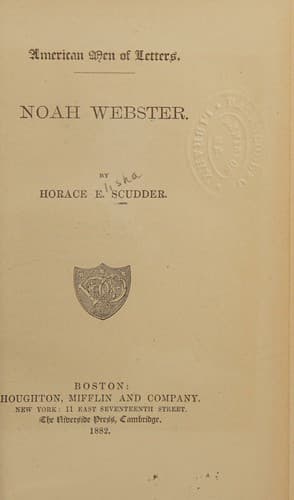
Noah Webster: American Men of LettersScudder, Horace Elisha
History
Noah Webster: American Men of Letters
Scudder, Horace Elisha
Educators -- United States -- Biography; Lexicographers -- United States -- Biography; Webster, Noah, 1758-1843
Washington, George, passes through New Haven, 5;
is escorted by N. W., 6;
his virtues commemorated in a spelling-book, 39;
Mirabeau, conscious of his own defects, wishes children early taught
the name of, 47;
visited by N. W., 56;
defended by N. W. against the Republicans, 131;
his connection with the French difficulties, 132.
Waterston, R. C., 184.
Watson, James, 130.
Webster, Daniel, letter to, from N. W., 57;
his part in passing copyright law, 66.
Webster, Mercy, 3.
Webster, Noah, born, 2;
his ancestry, 3;
his early education, 4;
at Yale College, 4;
escorts Washington and Lee through New Haven, 6;
serves as private in the Revolutionary Army, 7;
graduates and takes up school-teaching, 8;
studies law and teaches in Hartford, 9;
is admitted to the bar, 9;
resumes teaching at Sharon, 9;
has a tender regard for R. P., 11;
goes on sleighing parties, 11;
the influences about his youth, 13-32;
enters upon the making of school-books, 33;
his Grammatical Institute, 34;
his portrait, 35;
his aim in his early writings, 38;
his hints at orthographic reform, 40;
his early conversion in the matter of grammars, 42;
issues a new grammar, 43;
his views on usage, 44;
appeals to the pride of his countrymen, 45;
his Federalism, 46;
his attention to the political interests of America in his
reading-book, 47;
not a mere Anglo-phobian, 50;
his weakness and strength, 51;
sets out to secure copyright laws, 52;
makes a journey to Southern States, 56;
writes a letter to Daniel Webster on copyright laws, 57-61;
his publication of his Spelling-Book, 69;
his contracts with book-sellers, 70;
his venture in the American Magazine, 78;
his magazine projects, 80-93;
his enterprise, 94;
his publication of Winthrop's Journal, 95;
marries Rebecca Greenleaf, 96;
is outside of the Hartford Wits, 97;
writes a letter to Priestley, 104;
contributes to the "Connecticut Courant," 111;
publishes a pamphlet entitled "Sketches of American Policy," 113;
the product of certain forces, 118;
goes to Philadelphia at Franklin's request, 128;
writes "An Examination of the Leading Principles of the Federal
Constitution," 129;
editor of "The Minerva," 130;
his defense of the administration, 133;
discusses the French Revolution, 134;
writes "The Times," 134;
publishes a pamphlet on the French Revolution, 136;
defends Jay's Treaty, 137;
mistaken for Hamilton by Jefferson, 138;
his editorial skill, 138;
what he thought of slavery, 139;
closes his connection with "The Minerva," 142;
publishes further political works, 142;
his attack on Jefferson, 144;
at the polls, 145;
is concerned in the Hartford Convention, 146;
the ephemeral character of his political writings, 148;
his general average, 151;
Public-domain text, read in full here on John Shaqi.
Reviews
Reviews
No reviews yet
Be the first to share your thoughts on this work.
Elsewhere in the archive
Join the Discussion
Join the discussion
Sign in to leave a comment or review.
Sign InorCreate an account