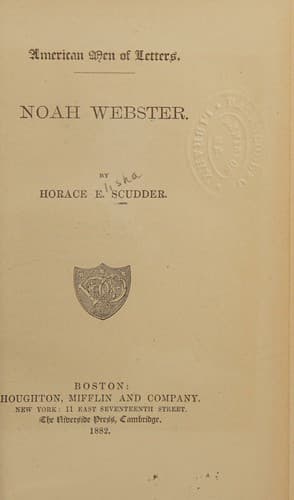
Noah Webster: American Men of LettersScudder, Horace Elisha
History
Noah Webster: American Men of Letters
Scudder, Horace Elisha
Educators -- United States -- Biography; Lexicographers -- United States -- Biography; Webster, Noah, 1758-1843
"Now in fact it is a very easy thing to pick up a needle, but if one
cannot stoop to pick it up another ought to be paid for it. One servant
who is paid for his work will pick up more needles than twenty fat,
lounging slaves that think it a drudgery and get nothing for it.
"It would be a good thing for a State to know that _everybody's business
is nobody's_. Every man in Connecticut is responsible for a faithful
collection of public money; then it is nobody's business. The Prompter
never saw a watch with two mainsprings, much less with two hundred. One
spring is enough, and that government, the executive of which depends
on many springs, will jar, clash, stop, and be always out of
order,--27,000l. in arrears.
"Appoint one collector, the treasurer; make him answerable for the
collection of the whole state revenue. Let him appoint his deputies; let
them be few, but let them be paid. All the difficulty will vanish; one
spring will move the whole; the state treasury, like the federal, will
be supplied; no arrears then, no levying executions on towns."
* * * * *
This happens to have its application to public affairs; most of the
twenty-eight papers have their special point in personal character. The
writing is not elegant; it is sometimes ungrammatical; but it is
intelligible, and with its bluntness could hardly fail to make itself
felt. It is when one compares it with similar work of Franklin's, as
"The Whistle," for example, that one is reminded of its inartistic form.
But Webster was always busy over subjects directly connected with the
well-being of the people. His philological work had its origin in this
motive, and in his miscellaneous writings he displayed his practical
philosophy and philanthropy. He wrote frequently upon banks and
banking; his "Epidemic and Pestilential Diseases" is pronounced by an
authority to have great historical value; he was one of the founders of
the Connecticut Academy of Arts and Sciences; and in the numerous list
of his writings one comes upon such oddly assorted subjects as an
account of a tornado in Wethersfield, a cure for cancer, upon
white-washing, the mental arithmetic of a negro, on winds, upon female
education, on the decomposition of white-lead paint, a dissertation on
the supposed change in the temperature of winter, upon names of streets
in New York, on yellow fever, on the age of literary men, and one
article with the suggestive title "Number of Deaths in the Episcopal
Church in New York in each Month for Ten Years." He had a passion for
statistics which took an odd turn. In his diary one constantly finds an
enumeration of the houses in the town which he happens to be visiting.
"During his brief residence in New York," says one biographical sketch,
"Mr. Webster numbered the houses in the city, and found that they were
thirty-five hundred." He would count up one side of a street and down
the other, and place the results in his note-book. I think he published
Public-domain text, read in full here on John Shaqi.
Reviews
Reviews
No reviews yet
Be the first to share your thoughts on this work.
Elsewhere in the archive
Join the Discussion
Join the discussion
Sign in to leave a comment or review.
Sign InorCreate an account