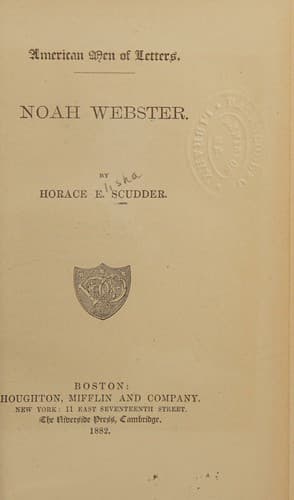
Noah Webster: American Men of LettersScudder, Horace Elisha
History
Noah Webster: American Men of Letters
Scudder, Horace Elisha
Educators -- United States -- Biography; Lexicographers -- United States -- Biography; Webster, Noah, 1758-1843
This passage from the Preface, as well as those papers in the volume
which follow the same style of orthography or rather cacography, will
illustrate well enough the unprincipled character of the reform as it
lay in Webster's mind. He acted upon the merest empiricism apparently,
without any well-considered plan, making the spelling occasionally
conform to the sound, but allowing even the same sounds to have
different representation in different words. Indeed, in the extract
given above, he appears to be rather a timid reformer, attacking such
defenseless little words as _is_, and respectfully passing by _would_
and _offered_. The general appearance of those essays in the volume
which are printed after Webster's own heart leads one happening upon
them nowadays into some disappointment, since they are by no means to be
ranked with the humorous writings of later mis-spellers, who have
contrived to get some fun out of venerable words by pulling off their
wigs and false teeth and turning them loose in the streets.
It is very likely that Webster's first impulse to reform our spelling
was given by Dr. Franklin's writings on the subject. As is well known,
that philosopher went so far as to devise new characters for compound
letters such as _th_, _sh_, _ng_, anticipating many of the later
experiment in phonic writing. Webster entered with zeal into the notion,
and held a correspondence with Franklin, in which the young man showed
himself so ardent a disciple of the old as to win for himself a certain
place as the doctor's residuary legatee in ideas. "This indefatigable
gentleman," says Webster of Franklin, "amidst all his other employments,
public and private, has compiled a Dictionary on his scheme of a reform,
and procured types to be cast for printing it. He thinks himself too old
to pursue the plan; but has honored me with the offer of the manuscript
and types, and expressed a strong desire that I should undertake the
task. Whether this project, so deeply interesting to this country, will
ever be effected, or whether it will be defeated by indolence and
prejudice, remains for my countrymen to determine." The last clause,
with all its obscurity, may be taken as a threat rather than as a
self-reproach. The entire correspondence between Webster and Franklin is
interesting as setting forth a certain excess of experimenting ardor in
Franklin and an unlooked-for degree of conservatism in Webster. Franklin
was the older man, but he was the more daring. One should credit him,
however, with a certain amount of humor in his whims. He played with
the English language, somewhat as he amused himself with conferring
legacies at compound interest, to take effect in two hundred years, and
giving away gravely millions of money by the immediate planting of a few
hundreds.
Public-domain text, read in full here on John Shaqi.
Reviews
Reviews
No reviews yet
Be the first to share your thoughts on this work.
Elsewhere in the archive
Join the Discussion
Join the discussion
Sign in to leave a comment or review.
Sign InorCreate an account