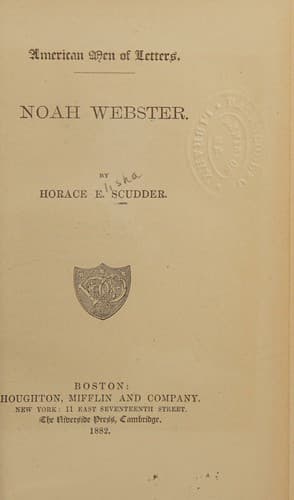
Noah Webster: American Men of LettersScudder, Horace Elisha
History
Noah Webster: American Men of Letters
Scudder, Horace Elisha
Educators -- United States -- Biography; Lexicographers -- United States -- Biography; Webster, Noah, 1758-1843
"In a few instances I have preferred the orthography of Newton,
Prideaux, Hook, Dryden, Whiston, etc., to that of Johnson, as being more
analogical and purely English, as _scepter_, _sepulcher_. In omitting
_u_ in _honour_ and a few words of that class I have pursued a common
practice in this country, authorized by the principle of uniformity and
by etymology, as well as by Ash's Dictionary. In omitting _k_ after _c_
[as in _public_] I have unequivocal propriety and the present usage for
my authorities. In a few words, modern writers are gradually purifying
the orthography from its corruptions. Thus, Edwards in his 'History of
the West Indies,' and Gregory in his 'Economy of Nature,' Pope, Hoole,
etc., restore _mold_ to its true spelling; and it would be no small
convenience to revive the etymological spelling of _aker_. Cullen, in
his translation of 'Clavigero,' follows Bacon and Davenport in the true
Saxon orthography of _drouth_; and the elegant Blackstone has corrected
the orthography of _nusance_ and _duchy_. The diphthongs in words
borrowed from the Latin language have gradually been sinking into
desuetude for a century; the few which remain I have expunged."
Dr. Johnson was the Magnus Apollo of lexicographers then, and his bulky
fame still casts a large shadow over the world of words. To rebel
against his autocratic rule at the beginning of this century was to
write one's self down an audacious and presuming sciolist. It is not
surprising, therefore, that Webster's criticism of Johnson in this
Dictionary and in other places should have exposed him to censure. Dr.
Ramsay of Charleston, a man of consequence in his day, wrote him that
the "prejudices against any American attempts to improve Dr. Johnson
were very strong in that city." The letter gave Webster his opportunity,
and he at once wrote and published his vigorous pamphlet respecting the
"Errors in Johnson's Dictionary and other Lexicons," which is addressed
to Dr. Ramsay. He takes a very lofty view of the situation. "The
intelligence," he writes, of this resentment in Charleston, "is not
wholly unexpected, for similar prejudices have been manifested in some
parts of the Northern States. A man who has read with slight attention
the history of nations, in their advances from barbarism to civilization
and science, cannot be surprised at the strength of prejudices long
established and never disturbed. Few centuries have elapsed since many
men lost their lives or their liberty by publishing NEW TRUTHS; and not
two centuries have past since Galileo was imprisoned by an
ecclesiastical court, for defending the truth of the Copernican System,
condemned to do penance for three years, and his book burnt at Rome, as
containing dangerous and damnable heresies. This example is cited as one
of a multitude which the history of man presents to our view; and if it
differs in _degree_, it accords in _principle_, with the case now before
the American public."
Public-domain text, read in full here on John Shaqi.
Reviews
Reviews
No reviews yet
Be the first to share your thoughts on this work.
Elsewhere in the archive
Join the Discussion
Join the discussion
Sign in to leave a comment or review.
Sign InorCreate an account