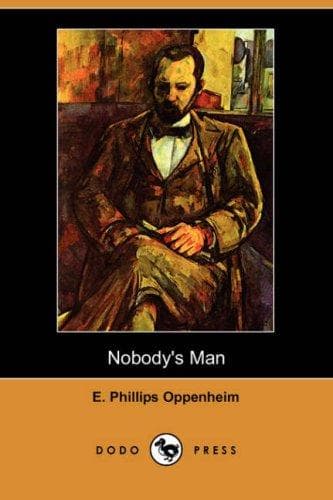
Nobody's ManOppenheim, E. Phillips (Edward Phillips)
General
Nobody's Man
Oppenheim, E. Phillips (Edward Phillips)
Detective and mystery stories
On the fifth day after Jane's departure, the thunderbolt fell.
Tallente's article was printed in full and the weaker members of the
Democratic Party shouted at once for his resignation. At a question
cunningly framed by Dartrey, Tallente rose in the House to defend his
position, and acting on the soundest axiom of military tactics, that the
best defence is attack, he turned upon Miller, and with caustic
deliberation exposed the plot framed for his undoing. He threw caution
to the winds, and though repeatedly and gravely called to order, he
poured out his scorn upon his enemy till the latter, white as a sheet,
rose to demand the protection of the Speaker. There were very few in
the House that day who ever forgot the almost terrifying spectacle of
Miller's collapse under his adversary's hurricane assault, or the proud
and dignified manner in which Tallente concluded his own defence. But
this was only the first step. The Labour Press throughout the country
took serious alarm at an attack which, though out of date and influenced
by conditions no longer predominant, yet struck a very lusty blow at the
very existence of their great nervous centres. Miller, as Chairman of
the Associated Trades Unions, issued a manifesto which, notwithstanding
his declining influence, exercised considerable effect. It seemed clear
that he could rely still upon a good ninety votes in the House of
Commons. Horlock became more cheerful. He met Tallente leaving the
House one windy March evening and the two men shared a taxi together,
westwards.
"Looks to me like another year of office, thanks to you," the Prime
Minister observed. "Lenton tells me that we shall have a majority of
forty on Thursday week. It is Thursday week you're going for us again,
isn't it?"
"Many things may happen before then," Tallente replied, with a little
affirmative nod. "Dartrey may decide that I am too expensive a luxury
and make friends with Miller."
"I don't think that's likely," Horlock pronounced. "Dartrey is a fine
fellow, although he is not a great politician. He is out to make a
radical and solid change in the government of this country and he knows
very well that Miller's gang will only be a dead weight around his neck.
He'd rather wait until he has weaned away a few more votes--even get rid
of Miller if he can--and stick to you."
"I think you are right," Tallente said. "I am keeping the Democrats
from a present triumph, but if through me they shake themselves free
from what I call the little Labourites, I think things will pan out
better for them in the long run."
"And in the meantime," Horlock went on, lighting a cigar and passing his
case to Tallente, "I must give you the credit of playing a magnificent
lone hand. I expected to see Miller fall down in a fit when you went
for him in the House. If only his army of adherents could have heard
that little duel, I think you'd have won straight through!"
Public-domain text, read in full here on John Shaqi.
Reviews
Reviews
No reviews yet
Be the first to share your thoughts on this work.
Elsewhere in the archive
Join the Discussion
Join the discussion
Sign in to leave a comment or review.
Sign InorCreate an account