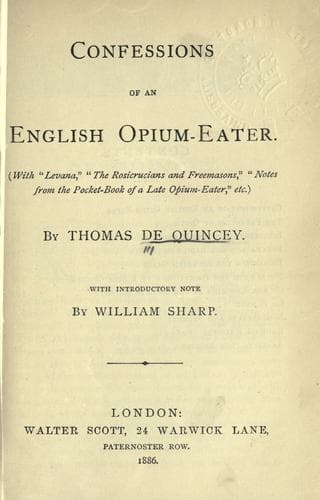
Note Book of an English Opium-EaterDe Quincey, Thomas
Philosophy
Note Book of an English Opium-Eater
De Quincey, Thomas
Opium abuse -- England
Of Swift, Mr. Schlosser selects for notice three works--the 'Drapier's
Letters,' 'Gulliver's Travels,' and the 'Tale of a Tub.' With respect to
the first, as it is a necessity of Mr. S. to be forever wrong in his
substratum of facts, he adopts the old erroneous account of Wood's
contract as to the copper coinage, and of the imaginary wrong which it
inflicted on Ireland. Of all Swift's villainies for the sake of
popularity, and still more for the sake of wielding this popularity
vindictively, none is so scandalous as this. In any new life of Swift the
case must be stated _de novo_. Even Sir Walter Scott is not impartial; and
for the same reason as now forces me to blink it, viz., the difficulty of
presenting the details in a readable shape. 'Gulliver's Travels' Schlosser
strangely considers 'spun out to an intolerable extent.' Many evil things
might be said of Gulliver; but not this. The captain is anything but
tedious. And, indeed, it becomes a question of mere mensuration, that can
be settled in a moment. A year or two since I had in my hands a pocket
edition, comprehending all the four parts of the worthy skipper's
adventures within a single volume of 420 pages. Some part of the space was
also wasted on notes, often very idle. Now the 1st part contains _two_
separate voyages (Lilliput and Blefuscu), the 2d, _one_, the 3d, _five_,
and the 4th, _one_; so that, in all, this active navigator, who has
enriched geography, I hope, with something of a higher quality than your
old muffs that thought much of doubling Cape Horn, here gives us _nine_
great discoveries, far more surprising than the pretended discoveries of
Sinbad (which are known to be fabulous), averaging _quam proxime_, forty-
seven small 16mo pages each. Oh you unconscionable German, built round in
your own country with circumvallations of impregnable 4tos, oftentimes
dark and dull as Avernus--that you will have the face to describe dear
excellent Captain Lemuel Gulliver of Redriff, and subsequently of Newark,
that 'darling of children and men,' as tedious. It is exactly because he
is _not_ tedious, because he does not shoot into German foliosity, that
Schlosser finds him '_intolerable_.' I have justly transferred to
Gulliver's use the words originally applied by the poet to the robin-
redbreast, for it is remarkable that _Gulliver_ and the _Arabian Nights_
are amongst the few books where children and men find themselves meeting
and jostling each other. This was the case from its first publication,
just one hundred and twenty years since. 'It was received,' says Dr.
Johnson, 'with such avidity, that the price of the first edition was
raised before the second could be made--it was read by the high and the
low, the learned and the illiterate. Criticism was lost in wonder. Now, on
the contrary, Schlosser wonders not at all, but simply criticises; which
we could bear, if the criticism were even ingenious. Whereas, he utterly
Public-domain text, read in full here on John Shaqi.
Reviews
Reviews
No reviews yet
Be the first to share your thoughts on this work.
Join the Discussion
Join the discussion
Sign in to leave a comment or review.
Sign InorCreate an account