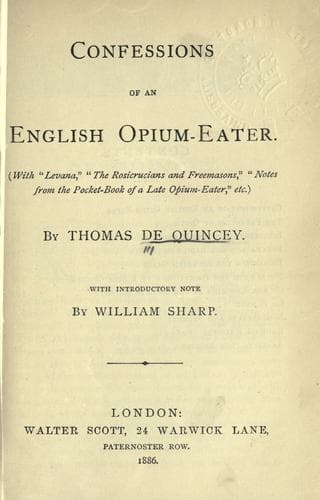
Note Book of an English Opium-EaterDe Quincey, Thomas
Philosophy
Note Book of an English Opium-Eater
De Quincey, Thomas
Opium abuse -- England
misunderstands Swift, and is a malicious calumniator of the captain who,
luckily, roaming in Sherwood, and thinking, often with a sigh, of his
little nurse, [3] Glumdalclitch, would trouble himself slightly about what
Heidelberg might say in the next century. There is but one example on our
earth of a novel received with such indiscriminate applause as 'Gulliver;'
and _that_ was 'Don Quixote.' Many have been welcomed joyfully by a class
--these two by a people. Now, could that have happened had it been
characterized by dulness? Of all faults, it could least have had _that_.
As to the 'Tale of a Tub,' Schlosser is in such Cimmerian vapors that no
system of bellows could blow open a shaft or tube through which he might
gain a glimpse of the English truth and daylight. It is useless talking to
such a man on such a subject. I consign him to the attentions of some
patriotic Irishman.
Schlosser, however, is right in a graver reflection which he makes upon
the prevailing philosophy of Swift, viz., that 'all his views were
directed towards what was _immediately_ beneficial, which is the
characteristic of savages.' This is undeniable. The meanness of Swift's
nature, and his rigid incapacity for dealing with the grandeurs of the
human spirit, with religion, with poetry, or even with science, when it
rose above the mercenary practical, is absolutely appalling. His own
_yahoo_ is not a more abominable one-sided degradation of humanity,
than is he himself under this aspect. And, perhaps, it places this
incapacity of his in its strongest light, when we recur to the fact of his
_astonishment_ at a religious princess refusing to confer a bishoprick
upon one that had treated the Trinity, and all the profoundest mysteries
of Christianity, not with mere scepticism, or casual sneer, but with set
pompous merriment and farcical buffoonery. This dignitary of the church,
Dean of the most conspicuous cathedral in Ireland, had, in full
canonicals, made himself into a regular mountebank, for the sake of giving
fuller effect, by the force of contrast, to the silliest of jests directed
against all that was most inalienable from Christianity. Ridiculing such
things, could he, in any just sense, be thought a Christian? But, as
Schlosser justly remarks, even ridiculing the peculiarities of Luther and
Calvin as he _did_ ridicule them, Swift could not be thought other
than constitutionally incapable of religion. Even a Pagan philosopher, if
made to understand the case, would be incapable of scoffing at any
_form_, natural or casual, simple or distorted, which might be
assumed by the most solemn of problems--problems that rest with the weight
of worlds upon the human spirit--
'Fix'd fate, free-will, fore-knowledge absolute.'
Public-domain text, read in full here on John Shaqi.
Reviews
Reviews
No reviews yet
Be the first to share your thoughts on this work.
Join the Discussion
Join the discussion
Sign in to leave a comment or review.
Sign InorCreate an account