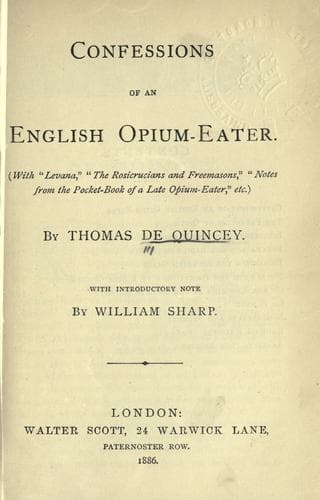
Note Book of an English Opium-EaterDe Quincey, Thomas
Philosophy
Note Book of an English Opium-Eater
De Quincey, Thomas
Opium abuse -- England
As to the _style_ of Swift, Mr. Schlosser shows himself without
sensibility in his objections, as the often hackneyed English reader shows
himself without philosophic knowledge of style in his applause. Schlosser
thinks the style of Gulliver 'somewhat dull.' This shows Schlosser's
presumption in speaking upon a point where he wanted, 1st, original
delicacy of tact; and, 2dly, familiar knowledge of English. Gulliver's
style is _purposely_ touched slightly with that dulness of
circumstantiality which besets the excellent, but 'somewhat dull' race of
men--old sea captains. Yet it wears only an aerial tint of dulness; the
felicity of this coloring in Swift's management is, that it never goes the
length of wearying, but only of giving a comic air of downright Wapping
and Rotherhithe verisimilitude. All men grow dull, and ought to be dull,
that live under a solemn sense of eternal danger, one inch only of plank
(often worm-eaten) between themselves and the grave; and, also, that see
for ever one wilderness of waters--sublime, but (like the wilderness on
shore) monotonous. All sublime people, being monotonous, have a tendency
to be dull, and sublime things also. Milton and Aeschylus, the sublimest
of men, are crossed at times by a shade of dulness. It is their weak side.
But as to a sea captain, a regular nor'-nor'-wester, and sou'-sou'-easter,
he ought to be kicked out of the room if he is _not_ dull. It is not
'ship-shape,' or barely tolerable, that he should be otherwise. Yet, after
all, considering what I have stated about Captain Gulliver's nine voyages
crowding into one pocket volume, he cannot really have much abused his
professional license for being dull. Indeed, one has to look out an excuse
for his being so little dull; which excuse is found in the fact that he
had studied three years at a learned university. Captain Gulliver, though
a sailor, I would have you to know, was a gownsman of Cambridge: so says
Swift, who knew more about the Captain than anybody now-a-days. Cantabs
are all horsemen, _ergo_, Gulliver was fit for any thing, from the
_wooden shoon_ of Cambridge up to the Horse Marines.
Now, on the other hand, you, common-place reader, that (as an old
tradition) believe Swift's style to be a model of excellence, hereafter I
shall say a word to you, drawn from deeper principles. At present I
content myself with these three propositions, which overthrow if you
can;--
1. That the merit, which justly you ascribe to Swift, is
_vernacularity_; he never forgets his mother-tongue in exotic forms,
unless we may call Irish exotic; for Hibernicisms he certainly has. This
merit, however, is exhibited--not, as _you_ fancy, in a graceful
artlessness, but in a coarse inartificiality. To be artless, and to be
inartificial, are very different things; as different as being natural and
being gross; as different as being simple and being homely.
Public-domain text, read in full here on John Shaqi.
Reviews
Reviews
No reviews yet
Be the first to share your thoughts on this work.
Elsewhere in the archive
Join the Discussion
Join the discussion
Sign in to leave a comment or review.
Sign InorCreate an account