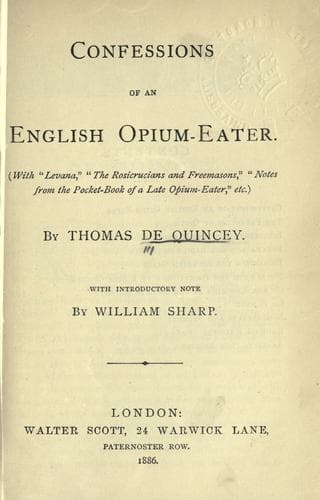
Note Book of an English Opium-EaterDe Quincey, Thomas
Philosophy
Note Book of an English Opium-Eater
De Quincey, Thomas
Opium abuse -- England
the destiny of man, or the relations of man to God. Anger, therefore,
Swift _might_ feel, and he felt it [7] to the end of his most wretched
life; but what reasonable ground had a man of sense for _astonishment_--
that a princess, who (according to her knowledge) was sincerely pious,
should decline to place such a man upon an Episcopal throne? This argues,
beyond a doubt, that Swift was in that state of constitutional irreligion,
irreligion from a vulgar temperament, which imputes to everybody else its
own plebeian feelings. People differed, he fancied, not by more and less
religion, but by more and less dissimulations. And, therefore, it seemed
to him scandalous that a princess, who must, of course, in her heart
regard (in common with himself) all mysteries as solemn masques and
mummeries, should pretend in a case of downright serious business, to pump
up, out of dry conventional hoaxes, any solid objection to a man of his
shining merit. '_The Trinity_,' for instance, _that_ he viewed as the
password, which the knowing ones gave in answer to the challenge of the
sentinel; but, as soon as it had obtained admission for the party within
the gates of the camp, it was rightly dismissed to oblivion or to
laughter. No case so much illustrates Swift's essential irreligion; since,
if he had shared in ordinary human feelings on such subjects, not only he
could not have been surprised at his own exclusion from the bench of
bishops, _after_ such ribaldries, but originally he would have abstained
from them as inevitable bars to clerical promotion, even upon principles
of public decorum.
Public-domain text, read in full here on John Shaqi.
Reviews
Reviews
No reviews yet
Be the first to share your thoughts on this work.
Join the Discussion
Join the discussion
Sign in to leave a comment or review.
Sign InorCreate an account