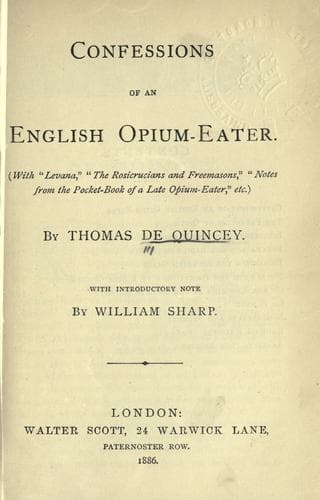
Note Book of an English Opium-EaterDe Quincey, Thomas
Philosophy
Note Book of an English Opium-Eater
De Quincey, Thomas
Opium abuse -- England
From Swift the scene changes to Addison and Steele. Steele is of less
importance; for, though a man of greater intellectual activity [4] than
Addison, he had far less of genius. So I turn him out, as one would turn
out upon a heath a ram that had missed his way into one's tulip preserve;
requesting him to fight for himself against Schlosser, or others that may
molest him. But, so far as concerns Addison, I am happy to support the
character of Schlosser for consistency, by assuring the reader that, of
all the monstrosities uttered by any man upon Addison, and of all the
monstrosities uttered by Schlosser upon any man, a thing which he says
about Addison is the worst. But this I reserve for a climax at the end.
Schlosser really puts his best leg foremost at starting, and one thinks
he's going to mend; for he catches a truth, viz., the following--that all
the brilliances of the Queen Anne period (which so many inconsiderate
people have called the Augustan age of our literature) 'point to this--
that the reading public wished to be entertained, not roused to think; to
be gently moved, not deeply excited.' Undoubtedly what strikes a man in
Addison, or _will_ strike him when indicated, is the coyness and
timidity, almost the girlish shame, which he betrays in the presence of
all the elementary majesties belonging to impassioned or idealized nature.
Like one bred in crowded cities, when first left alone in forests or
amongst mountains, he is frightened at their silence, their solitude,
their magnitude of form, or their frowning glooms. It has been remarked by
others that Addison and his companions never rise to the idea of
addressing the 'nation' or the 'people;' it is always the 'town.' Even
their audience was conceived of by _them_ under a limited form. Yet
for this they had some excuse in the state of facts. A man would like at
this moment to assume that Europe and Asia were listening to him; and as
some few copies of his book do really go to Paris and Naples, some to
Calcutta, there is a sort of legal fiction that such an assumption is
steadily taking root. Yet, unhappily, that ugly barrier of languages
interferes. Schamyl, the Circassian chief, though much of a savage, is not
so wanting in taste and discernment as to be backward in reading any book
of yours or mine. Doubtless he yearns to read it. But then, you see, that
infernal _Tchirkass_ language steps between our book, the darling,
and _him_, the discerning reader. Now, just such a barrier existed
for the Spectator in the travelling arrangements of England. The very few
old heavies that had begun to creep along three or four main roads,
depended so much on wind and weather, their chances of foundering were so
uncalculated, their periods of revolution were so cometary and uncertain,
that no body of scientific observations had yet been collected to warrant
a prudent man in risking a heavy bale of goods; and, on the whole, even
Public-domain text, read in full here on John Shaqi.
Reviews
Reviews
No reviews yet
Be the first to share your thoughts on this work.
Elsewhere in the archive
Join the Discussion
Join the discussion
Sign in to leave a comment or review.
Sign InorCreate an account