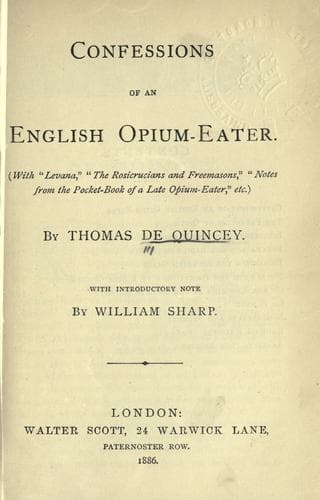
Note Book of an English Opium-EaterDe Quincey, Thomas
Philosophy
Note Book of an English Opium-Eater
De Quincey, Thomas
Opium abuse -- England
for York, Norwich, or Winchester, a consignment of '_Specs_' was not
quite a safe spec. Still, I could have told the Spectator who was anxious
to make money, where he might have been sure of a distant sale, though
returns would have been slow, viz., at Oxford and Cambridge. We know from
Milton that old Hobson delivered his parcels pretty regularly eighty years
before 1710. And, one generation before _that_, it is plain, by the
interesting (though somewhat Jacobinical) letters [5] of Joseph Mede, the
commenter on the Apocalypse, that news and politics of one kind or other
(and scandal of _every_ kind) found out for themselves a sort of
contraband lungs to breathe through between London and Cambridge; not
quite so regular in their _systole_ and _diastole_ as the tides of ebb and
flood, but better than nothing. If you consigned a packet into the proper
hands on the 1st of May, 'as sure as death' to speak _Scottice_, it would
be delivered within sixty miles of the capital before mid-summer. Still
there were delays; and these forced a man into carving his world out of
London. That excuses the word _town_.
Inexcusable, however, were many other forms of expression in those days,
which argued cowardly feelings. One would like to see a searching
investigation into the state of society in Anne's days--its extreme
artificiality, its sheepish reserve upon all the impassioned grandeurs,
its shameless outrages upon all the decencies of human nature. Certain it
is, that Addison (because everybody) was in that meanest of conditions
which blushes at any expression of sympathy with the lovely, the noble, or
the impassioned. The wretches were ashamed of their own nature, and
perhaps with reason; for in their own denaturalized hearts they read only
a degraded nature. Addison, in particular, shrank from every bold and
every profound expression as from an offence against good taste. He durst
not for his life have used the word 'passion' except in the vulgar sense
of an angry paroxysm. He durst as soon have danced a hornpipe on the top
of the 'monument' as have talked of a 'rapturous emotion.' What _would_ he
have said? Why, 'sentiments that were of a nature to prove agreeable after
an unusual rate.' In their odious verses, the creatures of that age talk
of love as something that 'burns' them. You suppose at first that they are
discoursing of tallow candles, though you cannot imagine by what
impertinence they address _you_, that are no tallow-chandler, upon such
painful subjects. And, when they apostrophize the woman of their heart
(for you are to understand that they pretend to such an organ), they
beseech her to 'ease their pain.' Can human meanness descend lower? As if
the man, being ill from pleurisy, therefore had a right to take a lady for
one of the dressers in an hospital, whose duty it would be to fix a
burgundy-pitch plaster between his shoulders. Ah, the monsters! Then to
read of their Phillises and Strephons, and Chloes, and Corydons--names
Public-domain text, read in full here on John Shaqi.
Reviews
Reviews
No reviews yet
Be the first to share your thoughts on this work.
Elsewhere in the archive
Join the Discussion
Join the discussion
Sign in to leave a comment or review.
Sign InorCreate an account