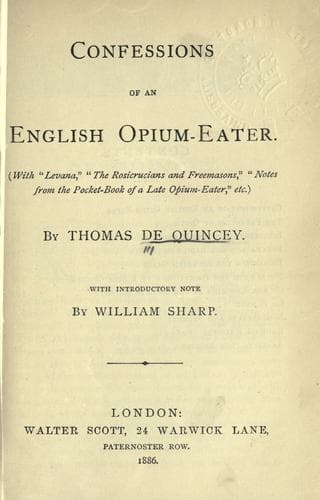
Note Book of an English Opium-EaterDe Quincey, Thomas
Philosophy
Note Book of an English Opium-Eater
De Quincey, Thomas
Opium abuse -- England
But now I will turn my whole fury in vengeance upon Schlosser. And,
looking round for a stone to throw at him, I observe this. Addison could
not be so entirely careless of exciting the public to think and feel, as
Schlosser pretends, when he took so much pains to inoculate that public
with a sense of the Miltonic grandeur. The 'Paradise Lost' had then been
published barely forty years, which was nothing in an age without reviews;
the editions were still scanty; and though no Addison could eventually
promote, for the instant he quickened, the circulation. If I recollect,
Tonson's accurate revision of the text followed immediately upon Addison's
papers. And it is certain that Addison [6] must have diffused the
knowledge of Milton upon the continent, from signs that soon followed. But
does not this prove that I myself have been in the wrong as well as
Schlosser? No: that's impossible. Schlosser's always in the wrong; but
it's the next thing to an impossibility that I should be detected in an
error: philosophically speaking, it is supposed to involve a
contradiction. 'But surely I said the very same thing as Schlosser by
assenting to what he said.' Maybe I did: but then I have time to make a
distinction, because my article is not yet finished; we are only at page
six or seven; whereas Schlosser can't make any distinction now, because
his book's printed; and his list of _errata_ (which is shocking though he
does not confess to the thousandth part), is actually published. My
distinction is--that, though Addison generally hated the impassioned,
and shrank from it as from a fearful thing, yet this was when it combined
with forms of life and fleshy realities (as in dramatic works), but not
when it combined with elder forms of eternal abstractions. Hence, he did
not read, and did not like Shakspeare; the music was here too rapid and
life-like: but he sympathized profoundly with the solemn cathedral
chanting of Milton. An appeal to his sympathies which exacted quick
changes in those sympathies he could not meet, but a more stationary
_key_ of solemnity he _could_. Indeed, this difference is illustrated
daily. A long list can be cited of passages in Shakspeare, which have been
solemnly denounced by many eminent men (all blockheads) as ridiculous: and
if a man _does_ find a passage in a tragedy that displeases him, it is
sure to seem ludicrous: witness the indecent exposures of themselves made
by Voltaire, La Harpe, and many billions beside of bilious people.
Whereas, of all the shameful people (equally billions and not less
bilious) that have presumed to quarrel with Milton, not one has thought
him ludicrous, but only dull and somnolent. In 'Lear' and in 'Hamlet,' as
in a human face agitated by passion, are many things that tremble on the
brink of the ludicrous to an observer endowed with small range of sympathy
or intellect. But no man ever found the starry heavens ludicrous, though
many find them dull, and prefer a near view of a brandy flask. So in the
Public-domain text, read in full here on John Shaqi.
Reviews
Reviews
No reviews yet
Be the first to share your thoughts on this work.
Elsewhere in the archive
Join the Discussion
Join the discussion
Sign in to leave a comment or review.
Sign InorCreate an account