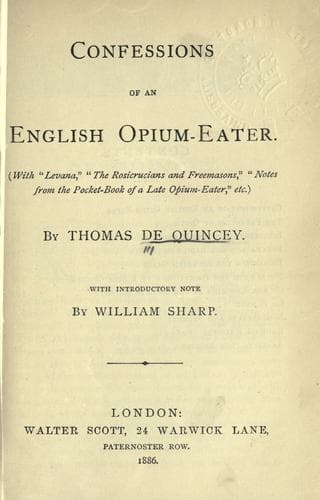
Note Book of an English Opium-EaterDe Quincey, Thomas
Philosophy
Note Book of an English Opium-Eater
De Quincey, Thomas
Opium abuse -- England
But, oh Castor and Pollux, whither--in what direction is it, that the man
is driving us? Positively, Schlosser, you must stop and let _me_ get
out. I'll go no further with such a drunken coachman. Many another absurd
thing I was going to have noticed, such as his utter perversion of what
Mandeville said about Addison (viz., by suppressing one word, and
misapprehending all the rest). Such, again, as his point-blank
misstatement of Addison's infirmity in his official character, which was
_not_ that 'he could not prepare despatches in a good style,' but
diametrically the opposite case--that he insisted too much on style, to
the serious retardation of public business. But all these things are as
nothing to what Schlosser says elsewhere. He actually describes Addison,
on the whole, as a 'dull prosaist,' and the patron of pedantry! Addison,
the man of all that ever lived most hostile even to what was good in
pedantry, to its tendencies towards the profound in erudition and the non-
popular; Addison, the champion of all that is easy, natural, superficial,
a pedant and a master of pedantry! Get down, Schlosser, this moment; or
let _me_ get out.
Pope, by far the most important writer, English or Continental, of his own
age, is treated with more extensive ignorance by Mr. Schlosser than any
other, and (excepting Addison) with more ambitious injustice. A false
abstract is given, or a false impression, of any one amongst his brilliant
works, that is noticed at all; and a false sneer, a sneer irrelevant to
the case, at any work dismissed by name as unworthy of notice. The three
works, selected as the gems of Pope's collection, are the 'Essay on
Criticism,' the 'Rape of the Lock,' and the 'Essay on Man.' On the first,
which (with Dr. Johnson's leave) is the feeblest and least interesting of
Pope's writings, being substantially a mere versification, like a metrical
multiplication-table, of common-places the most mouldy with which
criticism has baited its rat-traps; since nothing is said worth answering,
it is sufficient to answer nothing. The 'Rape of the Lock' is treated with
the same delicate sensibility that we might have looked for in Brennus, if
consulted on the picturesque, or in Attila the Hun, if adjured to decide
aesthetically, between two rival cameos. Attila is said (though no doubt
falsely) to have described himself as not properly a man so much as the
Divine wrath incarnate. This would be fine in a melodrama, with Bengal
lights burning on the stage. But, if ever he said such a naughty thing, he
forgot to tell us what it was that had made him angry; by what
_title_ did _he_ come into alliance with the Divine wrath, which
was not likely to consult a savage? And why did his wrath hurry, by forced
marches, to the Adriatic? Now so much do people differ in opinion, that,
to us, who look at him through a telescope from an eminence, fourteen
centuries distant, he takes the shape rather of a Mahratta trooper,
Public-domain text, read in full here on John Shaqi.
Reviews
Reviews
No reviews yet
Be the first to share your thoughts on this work.
Elsewhere in the archive
Join the Discussion
Join the discussion
Sign in to leave a comment or review.
Sign InorCreate an account