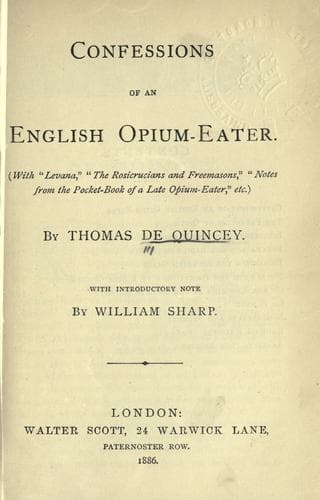
Note Book of an English Opium-EaterDe Quincey, Thomas
Philosophy
Note Book of an English Opium-Eater
De Quincey, Thomas
Opium abuse -- England
But there remains behind all these labors of Pope, the 'Dunciad,' which is
by far his greatest. I shall not, within the narrow bounds assigned to me,
enter upon a theme so exacting; for, in this instance, I should have to
fight not against Schlosser only, but against Dr. Johnson, who has
thoroughly misrepresented the nature of the 'Dunciad,' and, consequently,
could not measure its merits. Neither he, nor Schlosser, in fact, ever
read more than a few passages of this admirable poem. But the villany is
too great for a brief exposure. One thing only I will notice of
Schlosser's misrepresentations. He asserts (not when directly speaking of
Pope, but afterwards, under the head of Voltaire) that the French author's
trivial and random _Temple de Gout_ 'shows the superiority in this
species of poetry to have been greatly on the side of the Frenchman.'
Let's hear a reason, though but a Schlosser reason, for this opinion:
know, then, all men whom it concerns, that 'the Englishman's satire only
hit such people as would never have been known without his mention of
them, whilst Voltaire selected those who were still called great, and
their respective schools.' Pope's men, it seems, never _had_ been
famous--Voltaire's might cease to be so, but as yet they had _not_
ceased; as yet they commanded interest. Now mark how I will put three
bullets into that plank, riddle it so that the leak shall not be stopped
by all the old hats in Heidelberg, and Schlosser will have to swim for his
life. First, he is forgetting that, by his own previous confession,
Voltaire, not less than Pope, had 'immortalized a great many
_insignificant_ persons;' consequently, had it been any fault to do
so, each alike was caught in that fault; and insignificant as the people
might be, if they _could_ be 'immortalized,' then we have Schlosser
himself confessing to the possibility that poetic splendor should create a
secondary interest where originally there had been none. Secondly, the
question of merit does not arise from the object of the archer, but from
the style of his archery. Not the choice of victims, but the execution
done is what counts. Even for continued failures it would plead
advantageously, much more for continued and brilliant successes, that Pope
fired at an object offering no sufficient breadth of mark. Thirdly, it is
the grossest of blunders to say that Pope's objects of satire were obscure
by comparison with Voltaire's. True, the Frenchman's example of a scholar,
viz., the French Salmasius, was most accomplished. But so was the
Englishman's scholar, viz., the English Bentley. Each was absolutely
without a rival in his own day. But the day of Bentley was the very day of
Pope. Pope's man had not even faded; whereas the day of Salmasius, as
respected Voltaire had gone by for more than half a century. As to Dacier,
'_which_ Dacier, Bezonian?' The husband was a passable scholar--but
madame was a poor sneaking fellow, fit only for the usher of a boarding-
school.
Public-domain text, read in full here on John Shaqi.
Reviews
Reviews
No reviews yet
Be the first to share your thoughts on this work.
Elsewhere in the archive
Join the Discussion
Join the discussion
Sign in to leave a comment or review.
Sign InorCreate an account