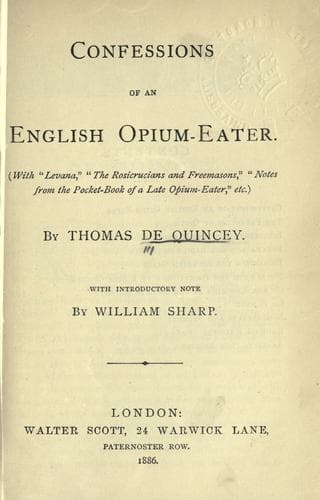
Note Book of an English Opium-EaterDe Quincey, Thomas
Philosophy
Note Book of an English Opium-Eater
De Quincey, Thomas
Opium abuse -- England
guess where Hume picked up his facts.
[11] Even in Dr. Francis's Translation of Select Speeches from
Demosthenes, which Lord Brougham naturally used a little in his own labors
on that theme, there may be traced several peculiarities of diction that
startle us in Junius. Sir P. had them from his father. And Lord Brougham
ought not to have overlooked them. The same thing may be seen in the notes
to Dr. Francis's translation of Horace. These points, though not
_independently_ of much importance, become far more so in combination
with others. The reply made to me once by a publisher of some eminence
upon this question, was the best fitted to lower Mr. Taylor's
investigation with a _stranger_ to the long history of the dispute.
'I feel,' he said, 'the impregnability of the case made out by Mr. Taylor.
But the misfortune is, that I have seen so many previous impregnable cases
made out for other claimants.' Ay, that _would_ be unfortunate. But
the misfortune for this repartee was, that I, for whose use it was
intended, not being in the predicament of a _stranger_ to the dispute,
having seen every page of the pleadings, knew all (except Mr. Taylor's) to
be false in their statements; after which their arguments signified
nothing.
THE ANTIGONE OF SOPHOCLES, AS REPRESENTED ON THE EDINBURGH STAGE.
Every thing in our days is new. _Roads_, for instance, which, being
formerly 'of the earth earthy,' and therefore perishable, are now iron,
and next door to being immortal; _tragedies_, which are so entirely
new, that neither we nor our fathers, through eighteen hundred and ninety
odd years, gone by, since Caesar did our little island the honor to sit
upon its skirts, have ever seen the like to this 'Antigone;' and, finally,
even more new are _readers_, who, being once an obedient race of men,
most humble and deferential in the presence of a Greek scholar, are now
become intractably mutinous; keep their hats on whilst he is addressing
them; and listen to him or not, as he seems to talk sense or nonsense.
Some there are, however, who look upon all these new things as being
intensely old. Yet, surely the railroads are new? No; not at all. Talus,
the iron man in Spenser, who continually ran round the island of Crete,
administering gentle warning and correction to offenders, by flooring them
with an iron flail, was a very ancient personage in Greek fable; and the
received opinion is, that he must have been a Cretan railroad, called The
Great Circular Coast-Line, that carried my lords the judges on their
circuits of jail-delivery. The 'Antigone,' again, that wears the freshness
of morning dew, and is so fresh and dewy in the beautiful person of Miss
Faucit, had really begun to look faded on the Athenian stage, and even 'of
a certain age,' about the death of Pericles, whose meridian year was the
year 444 before Christ. Lastly, these modern _readers_, that are so
obstinately rebellious to the once Papal authority of Greek, they--No; on
Public-domain text, read in full here on John Shaqi.
Reviews
Reviews
No reviews yet
Be the first to share your thoughts on this work.
Elsewhere in the archive
Join the Discussion
Join the discussion
Sign in to leave a comment or review.
Sign InorCreate an account