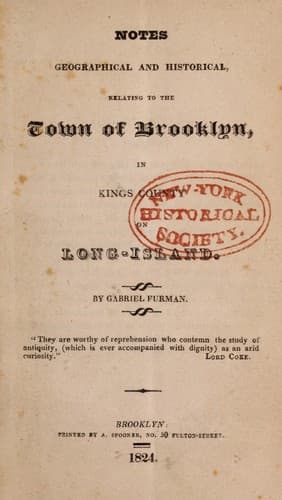
Notes Geographical and Historical, Relating to the Town of Brooklyn in Kings County on Long-IslandFurman, Gabriel
History
Notes Geographical and Historical, Relating to the Town of Brooklyn in Kings County on Long-Island
Furman, Gabriel
Brooklyn (New York, N.Y.) -- History
June 7, 1625, Sarah De Rapalje, born in this town. Tradition says that
she was the first white child born in the colony. Her parents were
Walloons; from whence is derived the name of Wallaboght, or Walloons
Bay, where they lived.[26] She was twice married. Her first husband was
Hans Hanse Bergen, by whom she had six children, viz. Michael Hanse,
Joris Hanse, Jan Hanse, Jacob Hanse, Brechje Hanse, and Marytje Hanse.
Her second husband was Teunis Guysbertse Bogart, by whom she also had
six children, viz. Aurtie Bogart, Antje Bogart, Neeltje Bogart, Aultje
Bogart, Catelyntje Bogart, and Guysbert Bogart. The account of Sarah De
Rapelje in the archives of the New-York Historical Society contains the
names of the persons to whom eleven of her children were married, and
tells the places where they settled. The twelfth, Brechje Hanse went to
Holland.
March 1, 1665, Hendrick Lubbertson and John Evertsen, appeared as
deputies from the town of Brooklyn, at the Assembly convened at
Hempstead, by order of Richard Nicolls, Deputy Governor under the Duke
of York; at which assembly the code of laws called the “Duke’s laws”
were adopted and published. In the appendix marked E. will be found the
address which these deputies, together with the others, sent to the Duke
of York; and which occasioned so much excitement in the Colony at that
period.
1671, This town, with five other towns in the West Riding of Yorkshire
upon Long-Island, petitioned the Court of Sessions “for liberty to
transport wheate,” which petition was referred to the Governor.
1687. The Clerk’s office of Kings County was kept in this town, by the
Deputy Register, Jacob Vandewater, who was also a Notary Public in this
town at the same period. The Register, Samuel Bayard, Esq. resided in
the city of New-York.
About the year 1691, there was a custom prevalent in this town of
calling a widow the “last wife” of her deceased husband; and a widower
the “last man” of his deceased wife.
The following is an Inventory of the estate which a bride in this town
brought with her to her husband in the year 1691. The husband by various
records appears to have been a man of considerable wealth;
notwithstanding which, the following inventory was thought by both of
them, of sufficient importance to merit being recorded, viz.
“A half worn bed, pillow, 2 cushions of ticking with feathers, one rug,
4 sheets, 4 cushion covers, 2 iron potts, 3 pewter dishes, 1 pewter
bason, 1 iron roaster, 1 schuryn spoon, 2 cowes about five yeares old, 1
case or cupboard, 1 table.”
Public-domain text, read in full here on John Shaqi.
Reviews
Reviews
No reviews yet
Be the first to share your thoughts on this work.
Elsewhere in the archive
Join the Discussion
Join the discussion
Sign in to leave a comment or review.
Sign InorCreate an account