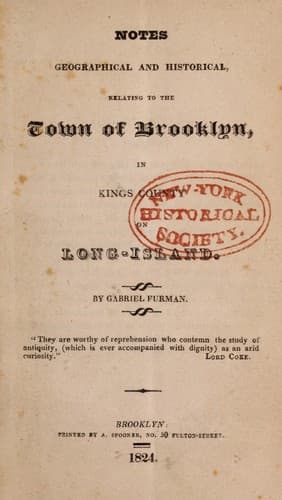
Notes Geographical and Historical, Relating to the Town of Brooklyn in Kings County on Long-IslandFurman, Gabriel
History
Notes Geographical and Historical, Relating to the Town of Brooklyn in Kings County on Long-Island
Furman, Gabriel
Brooklyn (New York, N.Y.) -- History
[28] The above deed to the Corporation of New-York did not extend
to the River. January 15, 1717, Samuel Garritsen, of Gravesend,
quitclaimed to David Aersen of Brooklyn, all his right and title to
a piece of land, “lying next to the house and land belonging to the
City of New-York, bounded north-west by the River, south-east by the
highway that goes to the ferry, south-west by the house and land
belonging to the City of New-York, and north-east by the house and
land belonging to the said John Rapalje, containing one acre be the
same more or less.” On the 16th day of the same month, David Aersen
sold this property to Gerrit Harsum of New-York, Gunsmith, for the sum
of _L_108 current money of New-York.
[29] The compiler congratulates his fellow citizens on the extinction
of those national animosities which in former times existed between
the Dutch and English in this our happy country. We may now truly ask
with Sterne, “are we not all relations?”
[30] “Lord Cornbury came to this province in very indigent
circumstances, hunted out of England by a host of hungry creditors,
he was bent on getting as much money as he could squeeze out of the
purses of an impoverished people.” He was infamous for his “excessive
avarice his embezzlement of the public money, and his sordid refusal
to pay his private debts.” Cornbury became so obnoxious to the
inhabitants of this province, that they sent a complaint to England
against him. The Queen in consequence of this complaint displaced
him. “As soon as his lordship was superseded, his creditors threw him
into the custody of the sheriff of New-York.” See Smith’s History
of New-York. Such was the man from whom the corporation of New-York
obtained the rights of the town of Brooklyn.
[31] These “divers former governors,” &c. are limited to two, viz.
Nicolls, who in 1665 granted them a charter, if that may be strictly
called so, which only altered their form of government from scout,
burgomasters, and schepens, to mayor and aldermen, without a word
about ferries or water rights, or indeed any other matter--the
original of which paper is not in existence. There is nothing to
warrant a belief that there was a charter of any kind granted to the
corporation between Nicolls and Dongan, who is the second of these
“divers former governors,” &c. and who in 1686 granted them the ferry,
(as is mentioned in a former part of this work) with an express
reservation as to the rights of all others. The charter of Dongan,
notwithstanding all their pompous recitals, is the oldest they can
produce, which in any manner affects the interests of this town.
[32] The corporation of New-York appear to have abandoned the right of
regulating the rate of ferriage very early; for in 1717, nine years
after the date of this charter, an act was passed by the colonial
legislature for that purpose.
Public-domain text, read in full here on John Shaqi.
Reviews
Reviews
No reviews yet
Be the first to share your thoughts on this work.
Elsewhere in the archive
Join the Discussion
Join the discussion
Sign in to leave a comment or review.
Sign InorCreate an account