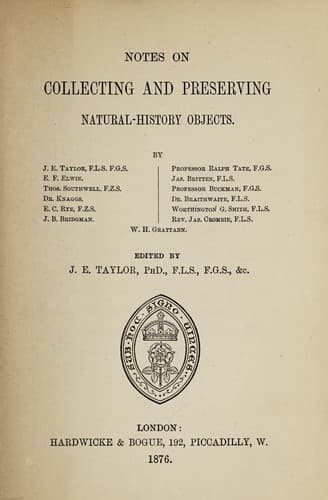
Notes on Collecting and Preserving Natural-History Objects
Science
Notes on Collecting and Preserving Natural-History Objects
Botanical specimens -- Collection and preservation; Zoological specimens -- Collection and preservation
With the fogs and rains of autumn the fungologist's harvest begins. A
few fungi (large and small) appertain to the spring, and some species
may be found in every month of the year; but it is not till September
has well set in, or October is reached, that the glut of fungi is
really upon us. Fungi may generally be met with in abundance for
three months of the year; viz. from the latter half of September till
the middle of December, the month of October taking pre-eminence for
producing the greatest abundance of species. A season of moderate heat
and rain is the most productive, for an excessive amount of either
dryness or moisture appears to destroy the fecundity of the mycelium,
which it must always be remembered is alive and at work (underground)
the whole of the year; for, as a matter of course, this year's fungi
is produced from last year's spores. These spores are set free in
autumn, and at once vegetate and form masses of mycelium, from which
next years crop must spring; just as the seeds of our wild annuals are
self-sown at the fall of each year and first germinate at that season.
It is a great mistake to suppose that Agarics and Boleti wait till
the leaves fall, so that they may prey upon them; for, as a rule, the
larger fungi never live upon the leaves of the same year as that in
which they (the fungi) come up; fungi live upon the fallen leaves of
the previous autumn. The spring and summer months will sometimes prove
very productive, especially after stormy weather; but the collector
must always bear in mind that fungi, like all other things, have
their _seasons_. I have known the fungus harvest quite over by the
end of August, and I have also known it not come in before December:
it depends entirely upon a certain amount of atmospheric heat and
moisture. A damp summer and stormy August will produce the crop at
the beginning of September; but a dry autumn, without much rain till
November, will delay the fungus crop till Christmas. Some species
appear regularly _twice_ a year from the same mycelium; once after the
rains of March and April, and again in October. This is the case with
_Coprinus atramentarius_, which I have growing (originally from spores)
in a bed of my own garden.
Public-domain text, read in full here on John Shaqi.
Reviews
Reviews
No reviews yet
Be the first to share your thoughts on this work.
Elsewhere in the archive
Join the Discussion
Join the discussion
Sign in to leave a comment or review.
Sign InorCreate an account