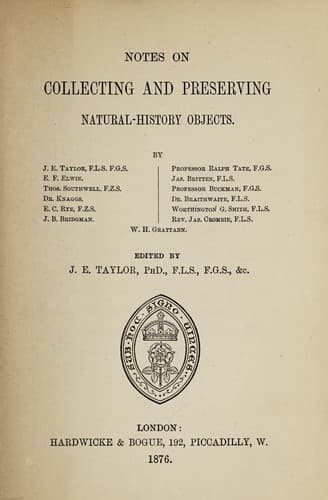
Notes on Collecting and Preserving Natural-History Objects
Science
Notes on Collecting and Preserving Natural-History Objects
Botanical specimens -- Collection and preservation; Zoological specimens -- Collection and preservation
It is useless to go out specially to collect fungi, either during the
dry hot weather of summer or the frosts of winter; it sometimes,
however, happens that odd fungi may be found here and there, in
out-of-the-way places, such as the sides of open cellars and sawpits,
under bridges, on prostrate logs in streams, in damp outhouses, or
about old water-butts, &c.; therefore I never go out without two or
three old seidlitz-powder boxes, some thin paper, and a strong knife,
in case any waifs and strays should fall in my way. I have sometimes
found good species in a friend's dustbin or cistern, or upon the sides
of the open cellar of a public-house. I once found an agaricus on
the cornice of London Bridge, to secure which I had to get over the
parapet, and was nearly being taken into custody as one tired of life;
another time I found a colony of _Coprinus domesticus_ upon a friend's
scullery wall, and a _Peziza_ upon my brother's ceiling. Moral:
Fungologists' pockets should, _at all times_, contain one or two small
boxes for securing stray and erratic members of the fungus family.
The equipment for a fungus foray differs with the nature of the fungi
to be collected. If the plants sought for are wholly microscopic, a
small vasculum, knife, pocket-lens, and package of thin paper will be
found sufficient; but if Agarics, Boleti, the larger Polyporei, &c.,
are to be brought home, a more complete set of things will be required,
which should include a very small garden-trowel or carpenter's gouge
(any saddler or bootmaker will make a suitable leather case for the
blades for a shilling or two), a strong knife--such as gardeners use
for pruning trees, a few sheets of thin paper, a lens, pocket-compass,
and some string. If truffles are desired, a rake is necessary, and the
best plan is to carry the iron-toothed end separately in a leather
case, and made to screw on to the end of a walking-stick; when not
in use, this end can be carried in the pocket with the trowel, &c.
It is requisite that the vasculum be large, with straps to carry it
over the shoulders; and the collector should be provided with a set of
cardboard boxes, large and small, to go inside the vasculum, and to
contain the more delicate or choice spoils of the day. Leather gloves
and a thin great-coat are good things for the chilly days of early
winter--this coat should be provided with at least four large pockets;
and, if the weather is inclement, strong boots and waterproof leggings
will be found serviceable. An old felt hat and large cotton umbrella
are also desirable, for it is only a piece of folly to go into the
wet dripping woods with good clothes. As for the umbrella, it should
be one of the Mrs. Gamp pattern, of good size, and with a (removable)
ring at the end farthest from the handle, so that it may be suspended
from branches of trees, &c., whilst the fungi are sorted or examined
below, or a frugal luncheon is discussed (perhaps during a passing
storm of rain).
Public-domain text, read in full here on John Shaqi.
Reviews
Reviews
No reviews yet
Be the first to share your thoughts on this work.
Elsewhere in the archive