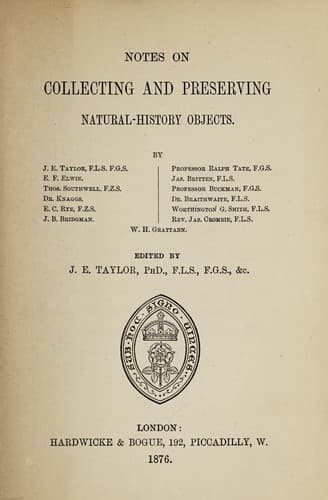
Notes on Collecting and Preserving Natural-History Objects
Science
Notes on Collecting and Preserving Natural-History Objects
Botanical specimens -- Collection and preservation; Zoological specimens -- Collection and preservation
_Pezizæ_, sits down, and after making a promising collection of horse
or cow-dung, carefully wraps these treasures in tissue paper, and puts
them in his "sandwich-box."
One word of warning to the beginner--never, on any account, amass
and put away a lot of imperfect materials with insufficient notes,
for in the end they will prove worse than useless. To name fungi
with certainty the fullest notes and most complete materials are
indispensable: without these nothing whatever can be done. It is far
better to laboriously make out twenty species, and know them in all
their aspects for certain, than to amass imperfect materials of two
thousand without any sound botanical knowledge. If the former course
is pursued, the study of fungi will prove a never-failing source of
pleasure to the mind and of health to the body.
In conclusion, I cannot do better than quote a few words written by the
illustrious Fries (now more than eighty years of age) in the preface
to a recent work of his on Fungi. He says: "Now in the evening of my
life, I rejoice to call to mind the abundant pleasures which my study
of the more perfect fungi, sustained for more than half a century, has
throughout this long time afforded me.... Therefore, to botanists,
who can wander at will the country side, I commend the study of these
plants as a perennial fountain of delight and admiration for that
Supreme Wisdom which reigns over universal nature."
XIII.
LICHENS.
By the Rev. Jas. Crombie, F.L.S., etc.
Much as it is to be regretted, it cannot be questioned that of those
who have devoted themselves to the study of botany, lichenists have
always been "few and far between." While flowering plants have had
their hosts of enthusiastic students, and while other classes of
cryptogamics have had due attention paid to them, the study of lichens
has, up even to the present time, been but too much neglected. To many
indeed the term conveys only some faint and confused idea, and though
they know that there are plants so called, they are at the same time
utterly ignorant of their nature. With flowering plants, ferns, mosses,
seaweeds, and even fungi, they have at least some acquaintance, more or
less accurate; but lichens they generally pass by with indifference,
regarding them merely as "time-stains" on the trees, the walls, and
the rocks where they grow. Nay, we have even met with some professed,
and otherwise well-informed botanists, who, while recognizing certain
of the larger and more conspicuous species as lichens, yet fancied
that many of the smaller and more obscure species were merely inorganic
discolorations. It is certainly very difficult to account for such a
state of matters at the present day, when so much attention is being
paid to almost every other class of plants. Vainly have I sought either
in the nature of the case itself or in my conversations with botanists,
for any intelligible solution of such apathy and neglect: though many
Public-domain text, read in full here on John Shaqi.
Reviews
Reviews
No reviews yet
Be the first to share your thoughts on this work.
Elsewhere in the archive
Join the Discussion
Join the discussion
Sign in to leave a comment or review.
Sign InorCreate an account