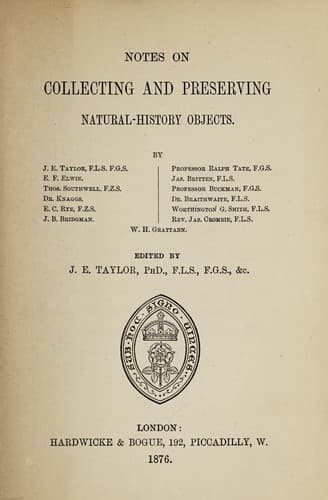
Notes on Collecting and Preserving Natural-History Objects
Science
Notes on Collecting and Preserving Natural-History Objects
Botanical specimens -- Collection and preservation; Zoological specimens -- Collection and preservation
When I think of the difficulties I experienced at the outset of my
study of marine botany, especially in the collecting and drying of
seaweeds, I feel strongly inclined to urge all beginners to obtain
some information concerning Marine Algæ before they go to the shore to
collect for themselves. A very few hours of study with an experienced
algologist, or even a perusal of some illustrated work on British algæ,
will save much trouble and materially assist the unpractised eye in
selecting specimens for the herbarium. I may here mention as highly
useful to incipient algologists Dr. Landsborough's 'British Seaweeds'
and Professor Harvey's 'Manual,' either of which may be obtained for a
few shillings; but if my readers are resident in London, I advise them
to pay a few visits to the Library of the British Museum, and there
inspect Dr. Harvey's 'Phycologia Britannica.' In this magnificent work
they will find coloured figures of nearly every British seaweed, with
drawings from magnified portions, and various structural details of the
highest value to students; and I once more impress on all collectors
the importance of some degree of book-learning ere they sally forth,
bag or vasculum in hand, to cull the lovely "flowers of the ocean," or
gather what best may please them from the rejectamenta on the shore.
If the collector wishes to learn, not merely the _names_ of plants,
but to distinguish _species_, he will do well to provide himself with
a copy of Harvey's little volume the 'Synopsis of British Seaweeds,'
and a Stanhope or Coddington lens, by means of which he can examine
portions of delicate plants as he finds them, and compare them with
the descriptions given in the 'Synopsis'; in this way, if he have any
success during his excursions, he will quickly become familiar with
most of the plants which are cast ashore or grow within tide-marks.
Time will not admit of, neither is space at present available for, a
single line beyond what may be practically serviceable to my youthful
readers; therefore I will hasten to describe the course of action in
seaweed-collecting as I have practised it for many years. At once,
then, to the shore, but not to the sandy shore, for only useless
decayed rubbish, or here and there some straggling plants of _Zostera
marina_, or grass-wrack, will be met with there. The collector must
away to the rocks, and search carefully every pool he meets with, from
a little distance below high-water mark, and so on down to the water's
edge, always remembering that it is better to collect while the tide is
receding than as it is coming in.
Public-domain text, read in full here on John Shaqi.
Reviews
Reviews
No reviews yet
Be the first to share your thoughts on this work.
Elsewhere in the archive
Join the Discussion
Join the discussion
Sign in to leave a comment or review.
Sign InorCreate an account