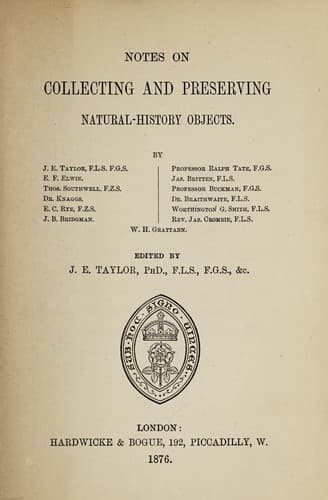
Notes on Collecting and Preserving Natural-History Objects
Science
Notes on Collecting and Preserving Natural-History Objects
Botanical specimens -- Collection and preservation; Zoological specimens -- Collection and preservation
Smooth drawing paper, or fine white cartridge paper, is generally
employed for mounting. The operator should be provided with three
different sizes of paper, and these should have each a piece of very
fine calico and four pieces of blotting-paper to correspond. The
process of mounting one of the filamentous or branching species is as
follows:--The specimen being cleaned and placed in the mounting dish, a
piece of paper of suitable size is laid on one of the perforated zinc
plates, and both are then slipped quickly under the floating weed.
The root or base of the specimen is then pressed down on the paper
with a finger of the left hand, while the right hand is employing
the forceps or porcupine quill in arranging the plant in as natural
a position as possible, ere the zinc plate is gently and gradually
raised at the top or bottom, as may be necessary, to ensure a perfect
display of every portion of the plant; but if, upon drawing it out of
the water, it should present an unsightly appearance from too thick an
overlapping of the branches, the whole must be reimmersed, and a little
pruning of superfluous portions may be employed with advantage to the
specimen and satisfaction to the operator. Care should be taken that
the water be drained off the paper as completely as possible before
the calico is laid over the plant, and this is accomplished by raising
the paper containing the plant as it still lies on the zinc plate, and
transferring it to a thin board placed in an inclined position against
one of the basins, and with the large camel-hair pencil _paint_ off
the water as it runs away from the specimen, and absorb what remains,
when the paper is laid flat, with the sponge. Delicate species may be
left to drain for a few minutes, while the operator is arranging other
specimens. When the water is sufficiently drained off, the paper is
then laid on the blotter, and the piece of calico is placed upon the
plant--a sheet of blotter being laid upon the calico.
Care should be observed in subjecting plants to pressure, which, in the
first instance, should be sufficient only to help the absorption of
water. The first set of blotting-papers should be changed in half an
hour after the whole batch of specimens have been placed in the press,
and these must be thoroughly dried before they are used again. After
the second or third change of blotters, the plants should remain under
strong pressure for two or three days; but the pieces of calico must
not be removed until it is pretty certain that the papers and plants
are quite dry.
Public-domain text, read in full here on John Shaqi.
Reviews
Reviews
No reviews yet
Be the first to share your thoughts on this work.
Elsewhere in the archive
Join the Discussion
Join the discussion
Sign in to leave a comment or review.
Sign InorCreate an account