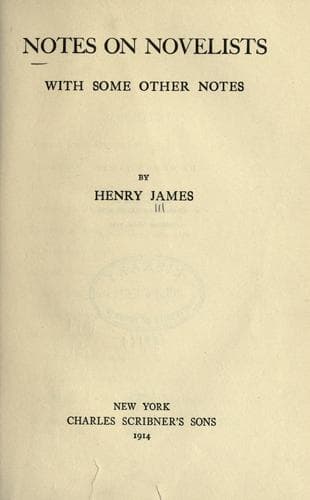
Notes on Novelists, with Some Other NotesJames, Henry
History
Notes on Novelists, with Some Other Notes
James, Henry
Fiction -- History and criticism; Novelists
What call, again, upon every sort of presence of mind could have been
livelier than the one made by the conditions attending and following the
marriage of young Solange Dudevant to the sculptor Clésinger in 1846,
when our heroine, summoned by the stress of events both to take
responsible action and to rise to synthetic expression, in a situation,
that is in presence of a series of demonstrations on her daughter’s
part, that we seem to find imaginable for a perfect dramatic adequacy
only in that particular home circle, fairly surpassed herself by her
capacity to “meet” everything, meet it much incommoded, yet undismayed,
unabashed and unconfuted, and have on it all, to her great advantage,
the always prodigious last word? The elements of this especial crisis
claim the more attention through its having been, as a test of her
powers, decidedly the most acute that she was in her whole course of
life to have traversed, more acute even, because more complicated, than
the great occasion of her rupture with Alfred de Musset, at Venice in
’35, on which such a wealth of contemplation and of ink has been
expended. Dramatic enough in their relation to each other certainly
those immortal circumstances, immortal so far as immortalised on either
side by genius and passion: Musset’s return, ravaged and alone, to
Paris; his companion’s transfer of her favour to Pietro Pagello, whom
she had called in to attend her friend medically in illness and whose
intervention, so far from simplifying the juncture, complicated it in a
fashion probably scarce paralleled in the history of the erotic
relation; her retention of Pagello under her protection for the rest of
her period in Venice; her marvellously domesticated state, in view of
the literary baggage, the collection of social standards, even taking
these but at what they were, and the general amplitude of personality,
that she brought into residence with her; the conveyance of Pagello to
Paris, on her own return, and the apparent signification to him at the
very gate that her countenance was then and there withdrawn. This was a
brilliant case for her—of coming off with flying colours; but it
strikes us as a mere preliminary flourish of the bow or rough practice
of scales compared to the high virtuosity which Madame Karénine’s new
material in respect to the latter imbroglio now enables us ever so
gratefully to estimate. The protagonist’s young children were in the
Venetian crisis quite off the scene, and on occasions subsequent to the
one we now glance at were old enough and, as we seem free to call it,
initiated enough not to solicit our particular concern for them; whereas
at the climax of the connection with Chopin they were of the perfect age
(which was the fresh marriageable in the case of Solange) to engage our
best anxiety, let alone their being of a salience of sensibility and
temper to leave no one of their aspects negligible. That their parent
Public-domain text, read in full here on John Shaqi.
Reviews
Reviews
No reviews yet
Be the first to share your thoughts on this work.
Elsewhere in the archive
Join the Discussion
Join the discussion
Sign in to leave a comment or review.
Sign InorCreate an account