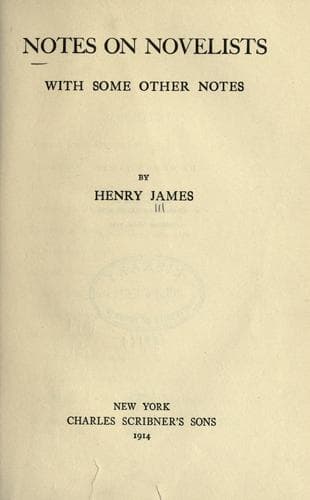
Notes on Novelists, with Some Other NotesJames, Henry
History
Notes on Novelists, with Some Other Notes
James, Henry
Fiction -- History and criticism; Novelists
In speaking as we have done of George Sand’s “use” of each twist of her
road as it came—a use which we now recognise as the very thriftiest—we
touch on that principle of vital health in her which made nothing that
might by the common measure have been called one of the graver dilemmas,
that is one of the checks to the continuity of life, really matter. What
this felicity most comes to in fact is that doing at any cost the work
that lies to one’s hand shines out again and yet again as the saving
secret of the soul. She affirmed her freedom right and left, but her
most characteristic assertion of it throughout was just in the luxury of
labour. The exhaustive account we at any rate now enjoy of the family
life surrounding her during the years here treated of and as she had
constituted it, the picture of all the queer conflicting sensibilities
engaged, and of the endless ramifications and reflections provided for
these, leaves us nothing to learn on that congested air, that
obstructive medium for the range of the higher tone, which the lady of
Nohant was so at her “objective” happiest, even if at her superficially,
that is her nervously, most flurried and depressed, in bravely
breasting. It is as if the conditions there and in Paris during these
several years had been consistently appointed by fate to throw into
relief the applications of a huge facility, a sort of universal
readiness, with a rare intelligence to back it. Absolutely nothing was
absent, or with all the data _could_ have been, that might have
bewildered a weaker genius into some lapse of eloquence or of industry;
everything that might have overwhelmed, or at least have disconcerted,
the worker who could throw off the splendid “Lucrezia Floriani” in the
thick of battle came upon her at once, inspiring her to show that on her
system of health and cheer, of experiential economy, as we may call it,
to be disconcerted was to be lost. To be lacerated and calumniated was
in comparison a trifle; with a certain sanity of reaction these things
became as naught, for the sanity of reaction was but the line of
consistency, the theory and attitude of sincerity kept at the highest
point. The artist in general, we need scarcely remind ourselves, is in a
high degree liable to arrive at the sense of what he may have seen or
felt, or said or suffered, by working it out as a subject, casting it
into some form prescribed by his art; but even here he in general knows
limits—unless perchance he be loose as Byron was loose, or possess such
a power of disconnection, such a clear stand-off of the intelligence, as
accompanied the experiments of Goethe. Our own experiments, we commonly
feel, are comparatively timid, just as we can scarce be said, in the
homely phrase, to serve our esthetic results of them hot and hot; we are
too conscious of a restrictive instinct about the conditions we may, in
like familiar language let ourselves in for, there being always the
Public-domain text, read in full here on John Shaqi.
Reviews
Reviews
No reviews yet
Be the first to share your thoughts on this work.
Elsewhere in the archive
Join the Discussion
Join the discussion
Sign in to leave a comment or review.
Sign InorCreate an account