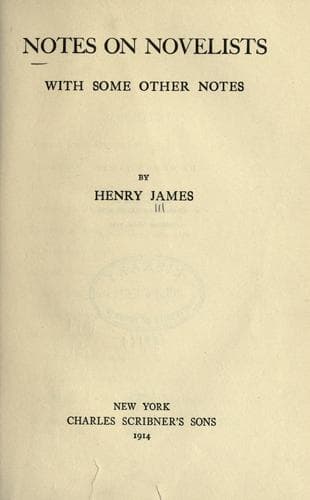
Notes on Novelists, with Some Other NotesJames, Henry
History
Notes on Novelists, with Some Other Notes
James, Henry
Fiction -- History and criticism; Novelists
I all but broke down under them utterly, though I had for long
seen them coming. But you know how one is not always overhung by
the evil portent, however clear one may read it—there are days,
weeks, even whole months, when one lives on illusion and fondly
hopes to divert the blow that threatens. It is always at last
the most probable ill that surprises us unarmed and unprepared.
To this explosion of unhappy underground germs joined themselves
sundry contributive matters, bitter things too and quite
unexpected; so that I am broken by grief in body and soul. I
believe my grief incurable, for I never succeed in throwing it
off for a few hours without its coming upon me again during the
next in greater force and gloom. I nevertheless struggle against
it without respite, and if I don’t hope for a victory which
would have to consist of not feeling at all, at least I have
reached that of still bearing with life, of even scarcely
feeling ill, of having recovered my taste for work and of not
showing my distress. I have got back outside calm and cheer,
which are so necessary for others, and everything in my life
seems to go on well.
We had already become aware, through commemorations previous to the
present, of that first or innermost line of defence residing in George
Sand’s splendid mastery of the letter, the gift that was always so to
assure her, on every issue, the enjoyment of the first chance with
posterity. The mere cerebral and manual activity represented by the
quantity no less than the quality of her outflow through the post at a
season when her engagements were most pressing and her anxieties of
every sort most cruel is justly qualified by Madame Karénine as
astounding; the new letters here given to the world heaping up the
exhibition and testifying even beyond the finest of those gathered in
after the writer’s death—the mutilations, suppressions and other
freedoms then used, for that matter, being now exposed. If no plot of
her most bustling fiction ever thickened at the rate at which those
agitations of her inner circle at which we have glanced multiplied upon
her hands through the later ’forties, so we are tempted to find her
rather less in possession of her great _moyens_ when handling the
artificial presentation than when handling what we may call the natural.
It is not too much to say that the long letter addressed to the cynical
Solange in April ’52, and which these pages give us _in extenso_, would
have made the fortune of any mere interesting “story” in which one of
the characters might have been presented as writing it. It is a document
of the highest psychological value and a practical summary of all the
elements of the writer’s genius, of all her indefeasible advantages; it
is verily the gem of her biographer’s collection. Taken in connection
with a copious communication to her son, of the previous year, on the
Public-domain text, read in full here on John Shaqi.
Reviews
Reviews
No reviews yet
Be the first to share your thoughts on this work.
Elsewhere in the archive
Join the Discussion
Join the discussion
Sign in to leave a comment or review.
Sign InorCreate an account