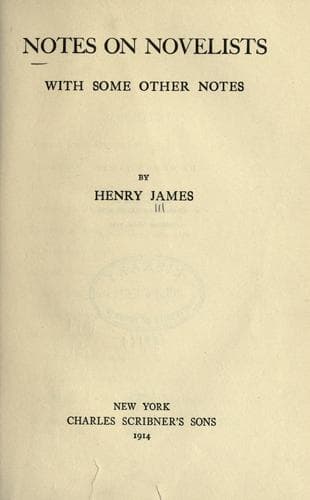
Notes on Novelists, with Some Other NotesJames, Henry
History
Notes on Novelists, with Some Other Notes
James, Henry
Fiction -- History and criticism; Novelists
Autobiographic in form, “L’Innocente” sticks closely to its theme, and
though the form is on the whole a disadvantage to it the texture is
admirably close. The question is of nothing less than a young husband’s
relation to the illegitimate child of his wife, born confessedly as
such, and so born, marvellous to say, in spite of the circumstance that
the wife adores him, and of the fact that, though long grossly, brutally
false to her, he also adores his wife. To state these data is
sufficiently to express the demand truly made by them for superiority of
treatment; they require certainly two or three almost impossible
postulates. But we of course never play the fair critical game with an
author, never get into relation with him at all, unless we grant him his
postulates. His subject is what is given him—given him by influences,
by a process, with which we have nothing to do; since what art, what
revelation, can ever really make such a mystery, such a passage in the
private life of the intellect, adequately traceable for us? His
treatment of it, on the other hand, is what he actively gives; and it is
with what he gives that we are critically concerned. If there is nothing
in him that effectually induces us to make the postulate, he is then
empty for us altogether, and the sooner we have done with him the
better; little as the truly curious critic enjoys, as a general thing,
having publicly to throw up the sponge.
Tullio Hermil, who finally compasses the death of the little “innocent,”
the small intruder whose presence in the family life has become too
intolerable, retraces with a master’s hand each step of the process by
which he has arrived at this sole issue. Save that his wife dumbly
divines and accepts it his perpetration of the deed is not suspected,
and we take the secret confession of which the book consists as made for
the relief and justification of his conscience. The action all goes
forward in that sphere of exasperated sensibility which Signor
D’Annunzio has made his own so triumphantly that other story-tellers
strike us in comparison as remaining at the door of the inner precinct,
as listening there but to catch an occasional faint sound, while he
alone is well within and moving through the place as its master. The
sensibility has again in itself to be qualified; the exasperation of
feeling is ever the essence of the intercourse of some man with some
woman who has reduced him, as in “L’Innocente” and in “Il Trionfo,” to
homicidal madness, or of some woman with some man who, as in “Il Fuoco,”
and also again by a strange duplication of its office in “L’Innocente,”
causes her atrociously to suffer. The plane of the situation is thus
visibly a singularly special plane; that, always, of the more or less
insanely demoralised pair of lovers, for neither of whom is any other
personal relation indicated either as actual or as conceivably possible.
Here, it may be said on such a showing, is material rather alarmingly
Public-domain text, read in full here on John Shaqi.
Reviews
Reviews
No reviews yet
Be the first to share your thoughts on this work.
Elsewhere in the archive
Join the Discussion
Join the discussion
Sign in to leave a comment or review.
Sign InorCreate an account