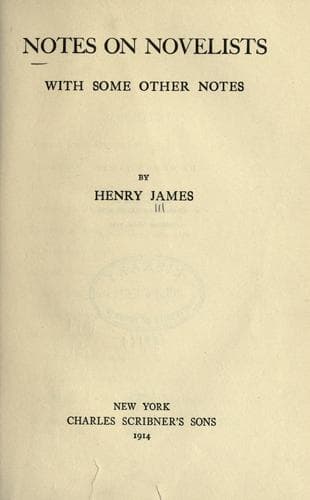
Notes on Novelists, with Some Other NotesJames, Henry
History
Notes on Novelists, with Some Other Notes
James, Henry
Fiction -- History and criticism; Novelists
Let us profess all readiness to repeat that we may still have had, on
the merest “life” system, or that of the starkest crudity of the slice,
all the entertainment that can come from watching a wayfarer engage with
assurance in an alley that we know to have no issue—and from watching
for the very sake of the face that he may show us on reappearing at its
mouth. The recitals of Mr. Arnold Bennett, Mr. Gilbert Cannan, Mr. D. H.
Lawrence, fairly smell of the real, just as the “Fortitude” and “The
Duchess” of Mr. Hugh Walpole smell of the romantic; we have sufficiently
noted then that, once on the scent, we are capable of pushing ahead. How
far it is at the same time from being all a matter of smell the terms in
which we just above glanced at the weakness of the spell of the
happy-go-lucky may here serve to indicate. There faces us all the while
the fact that the act of consideration as an incident of the esthetic
pleasure, consideration confidently knowing us to _have_ sooner or later
to arrive at it, may be again and again postponed, but can never hope
not some time to fall due. Consideration is susceptible of many forms,
some one or other of which no conscious esthetic effort fails to cry out
for; and the simplest description of the cry of the novel when
sincere—for have we not heard such compositions bluff us, as it were,
with false cries?—is as an appeal to us when we have read it once to
read it yet again. _That_ is the act of consideration; no other process
of considering approaches this for directness, so that anything short of
it is virtually not to consider at all. The word has sometimes another
sense, that of the appeal to us _not_, for the world, to go back—this
being of course consideration of a sort; the sort clearly that the truly
flushed production should be the last to invoke. The effect of
consideration, we need scarce remark, is to light for us in a work of
art the hundred questions of how and why and whither, and the effect of
these questions, once lighted, is enormously to thicken and complicate,
even if toward final clarifications, what we have called the amused
state produced in us by the work. The more our amusement multiplies its
terms the more fond and the more rewarded consideration becomes; the
fewer it leaves them, on the other hand, the less to be resisted for us
is the impression of “bare ruined choirs where late the sweet birds
sang.” Birds that have appeared to sing, or whose silence we have not
heeded, on a first perusal, prove on a second to have no note to
contribute, and whether or no a second is enough to admonish us of those
we miss, we mostly expect much from it in the way of emphasis of those
we find. Then it is that notes of intention become more present or more
absent; then it is that we take the measure of what we have already
called our effective provision. The bravest providers and designers show
at this point something still in store which only the second rummage was
appointed to draw forth.
Public-domain text, read in full here on John Shaqi.
Reviews
Reviews
No reviews yet
Be the first to share your thoughts on this work.
Elsewhere in the archive
Join the Discussion
Join the discussion
Sign in to leave a comment or review.
Sign InorCreate an account