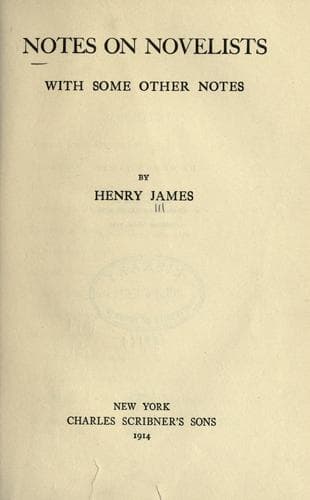
Notes on Novelists, with Some Other NotesJames, Henry
History
Notes on Novelists, with Some Other Notes
James, Henry
Fiction -- History and criticism; Novelists
interest us more than to see the exemplary value of attention, attention
given by the author and asked of the reader, attested in a case in which
it has had almost unspeakable difficulties to struggle with—since so we
are moved to qualify the particular difficulty Mr. Conrad has “elected”
to face: the claim for method in itself, method in this very sense of
attention applied, would be somehow less lighted if the difficulties
struck us as less consciously, or call it even less wantonly, invoked.
What they consist of we should have to diverge here a little to say, and
should even then probably but lose ourselves in the dim question of why
so special, eccentric and desperate a course, so deliberate a plunge
into threatened frustration, should alone have seemed open. It has been
the course, so far as three words may here serve, of his so multiplying
his creators or, as we are now fond of saying, producers, as to make
them almost more numerous and quite emphatically more material than the
creatures and the production itself in whom and which we by the general
law of fiction expect such agents to lose themselves. We take for
granted by the general law of fiction a primary author, take him so much
for granted that we forget him in proportion as he works upon us, and
that he works upon us most in fact by making us forget him.
Mr. Conrad’s first care on the other hand is expressly to posit or set
up a reciter, a definite responsible intervening first person singular,
possessed of infinite sources of reference, who immediately proceeds to
set up another, to the end that this other may conform again to the
practice, and that even at that point the bridge over to the creature,
or in other words to the situation or the subject, the thing “produced,”
shall, if the fancy takes it, once more and yet once more glory in a
gap. It is easy to see how heroic the undertaking of an effective fusion
becomes on these terms, fusion between what we are to know and that
prodigy of our knowing which is ever half the very beauty of the
atmosphere of authenticity; from the moment the reporters are thus
multiplied from pitch to pitch the tone of each, especially as
“rendered” by his precursor in the series, becomes for the prime poet of
all an immense question—these circumferential tones having not only to
be such individually separate notes, but to keep so clear of the others,
the central, the numerous and various voices of the agents proper, those
expressive of the action itself and in whom the objectivity resides. We
usually escape the worst of this difficulty of a tone _about_ the tone
of our characters, our projected performers, by keeping it single,
keeping it “down” and thereby comparatively impersonal or, as we may
say, inscrutable; which is what a creative force, in its blest fatuity,
likes to be. But the omniscience, remaining indeed nameless, though
constantly active, which sets Marlow’s omniscience in motion from the
Public-domain text, read in full here on John Shaqi.
Reviews
Reviews
No reviews yet
Be the first to share your thoughts on this work.
Elsewhere in the archive
Join the Discussion
Join the discussion
Sign in to leave a comment or review.
Sign InorCreate an account