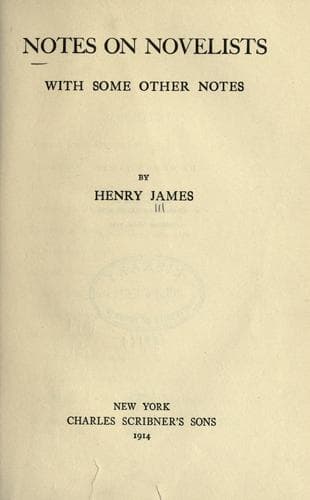
Notes on Novelists, with Some Other NotesJames, Henry
History
Notes on Novelists, with Some Other Notes
James, Henry
Fiction -- History and criticism; Novelists
_civilisation_—the particular civilisation that a young roaring and
money-getting democracy, inevitably but almost exclusively occupied with
“business success,” most needed to have brought home to it. The New
England air in especial was no natural conductor of any appeal to an
esthetic aim, but the interest of Professor Norton’s general work, to
say nothing of the interest of his character for a closer view, is
exactly that the whole fruitful enterprise was to prove intimately a New
England adventure; illustrating thus at the same time and once more the
innate capacity of New England for leavening the great American mass on
the finer issues.
To have grown up as the accomplished man at large was in itself at that
time to have felt, and even in some degree to have suffered, this hand
of differentiation; the only accomplished men of the exhibited New
England Society had been the ministers, the heads of the
congregations—whom, however, one docks of little of their credit in
saying that their accomplishments and their earnestness had been almost
wholly in the moral order. The advantage of that connection was indeed
what Norton was fundamentally to have enjoyed in his descent, both on
his father’s and his mother’s side (pre-eminently on the latter, the
historic stock of the Eliots) from a long line of those stalwart
pastoral worthies who had notably formed the aristocracy of
Massachusetts. It was largely, no doubt, to this heritage of character
and conscience that he owed the strong and special strain of confidence
with which he addressed himself to the business of perfect candour
toward his fellow-citizens—his pupils in particular; they, to whom this
candour was to become in the long run the rarest and raciest and most
endearing of “treats,” being but his fellow-citizens in the making. This
view of an urgent duty would have been a comparatively slight thing,
moreover, without the special preoccupations, without the love of the
high humanities and curiosities and urbanities in themselves, without
the conception of science and the ingrained studious cast of mind, which
had been also an affair of heredity with him and had opened his eyes
betimes to educative values and standards other than most of those he
saw flourish near at hand. He would defer to dilettantism as little as
to vulgarity, and if he ultimately embraced the fine ideal of taking up
the work that lay close to him at home, and of irrigating the immediate
arid tracts and desert spaces, it was not from ignorance of the
temptation to wander and linger where the streams already flowed and the
soil had already borne an abiding fruit.
Public-domain text, read in full here on John Shaqi.
Reviews
Reviews
No reviews yet
Be the first to share your thoughts on this work.
Elsewhere in the archive
Join the Discussion
Join the discussion
Sign in to leave a comment or review.
Sign InorCreate an account