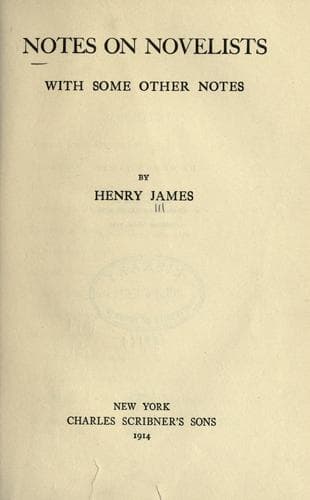
Notes on Novelists, with Some Other NotesJames, Henry
History
Notes on Novelists, with Some Other Notes
James, Henry
Fiction -- History and criticism; Novelists
Professor Norton’s pre-eminent work in the interpretation of Dante—by
which I mean his translation, text and notes, of the “Divine Comedy” and
the “New Life,” an achievement of infinite piety, patience and resource;
his admirable volume on Church-Building in the Middle Ages (to say
nothing of his charming earlier one, “Study and Travel in Italy,”
largely devoted to the cathedral of Orvieto); his long and intimate
friendship with Ruskin, commemorated by his publication, as
joint-executor to Ruskin’s will, of the best fruits of the latter’s
sustained correspondence with him; his numerous English friendships, in
especial—to say nothing of his native—all with persons of a highly
representative character: these things give in part the measure of his
finest curiosities and of his appetite, in all directions, for the best
sources and examples and the best company. But it is probable that if
his Harvard lectures are in form for publication, and if his general
correspondence, and above all his own easily handsomest show in it,
comes to be published, as most emphatically it should be, they will
testify not in the least to any unredeemed contraction of life, but to
the largest and happiest and most rewarded energy. An exhilarated
invocation of close responsibility, an absolute ease of mind about one’s
point of view, a thorough and never-failing intellectual wholeness, are
so far from weakening the appeal to young allegiances that, once they
succeed at all, they succeed the better for going all their length. So
it was that, with admirable urbanity of form and uncompromising
straightness of attack, the Professor of the History of the Fine Arts at
Harvard for a quarter of a century let himself go; thinking no trouble
wasted and no flutter and no scandal other than auspicious if only he
might, to the receptive and aspiring undergraduate mind, brand the ugly
and the vulgar and the inferior wherever he found them, tracking them
through plausible disguises and into trumpery strongholds; if only he
might convert young products of the unmitigated American order into
material for men of the world in the finer sense of that term; if only
in short he might render more supple their view, liable to obfuscation
from sights and sounds about them, of the true meaning of a liberal
education and of the civilised character and spirit in the civilised
State.
Public-domain text, read in full here on John Shaqi.
Reviews
Reviews
No reviews yet
Be the first to share your thoughts on this work.
Elsewhere in the archive
Join the Discussion
Join the discussion
Sign in to leave a comment or review.
Sign InorCreate an account