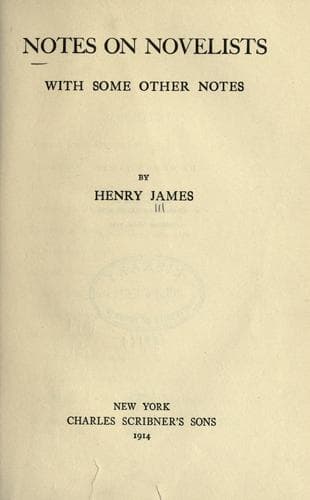
Notes on Novelists, with Some Other NotesJames, Henry
History
Notes on Novelists, with Some Other Notes
James, Henry
Fiction -- History and criticism; Novelists
One may perhaps take these things too hard and read into them foolish
fancies; but the hush in question was filled to my imagination—quite
apart from the listening faces, of which there would be special things
to say that I wouldn’t for the world risk—with the great picture of all
the old grey quads and old green gardens, of all the so totally
different traditions and processions that were content at last, if only
for the drowsy end of a summer afternoon, to range themselves round and
play at hospitality. What it appeared possible to make out was a certain
faint convergence: that was the idea of which, during the whole process,
I felt the agreeable obsession. From the moment it brushed the mind
certainly the impulse was to clutch and detain it: too doleful would it
have been to entertain for an instant the fear that M. Bourget’s lecture
could leave the two elements of his case facing each other only at the
same distance at which it had found them. No, no; there was nothing for
it but to assume and insist that with each tick of the clock they moved
a little nearer together. That was the process, as I have called it, and
none the less interesting to the observer that it may not have been, and
may not yet be, rapid, full, complete, quite easy or clear or
successful. It was the seed of contact that assuredly was sown; it was
the friendly beginning that in a manner was made. The situation was
handled and modified—the day was a date. I shall perhaps remain obscure
unless I say more expressly and literally that the particular thing into
which, for the perfect outsider, the occasion most worked was a lively
interest—so far as an outsider could feel it—in the whole odd
phenomenon and spectacle of a certain usual positive _want_ of
convergence, want of communication between what the seat and habit of
the classics, the famous frequentation and discipline, do for their
victims in one direction and what they do not do for them in another.
Was the invitation to M. Bourget not a dim symptom of a bridging of this
queerest of all chasms? I can only so denominate—as a most anomalous
gap—the class of possibilities to which we owe its so often coming over
us in England that the light kindled by the immense academic privilege
is apt suddenly to turn to thick smoke in the air of contemporary
letters.
Public-domain text, read in full here on John Shaqi.
Reviews
Reviews
No reviews yet
Be the first to share your thoughts on this work.
Elsewhere in the archive
Join the Discussion
Join the discussion
Sign in to leave a comment or review.
Sign InorCreate an account